We use cookies to improve your experience on our site. By using our site, you consent to the use of cookies. Rejecting cookies will prevent non-essential cookies from loading.
Linden Fairbridge Advisory · Information Briefing · 16 August 2026
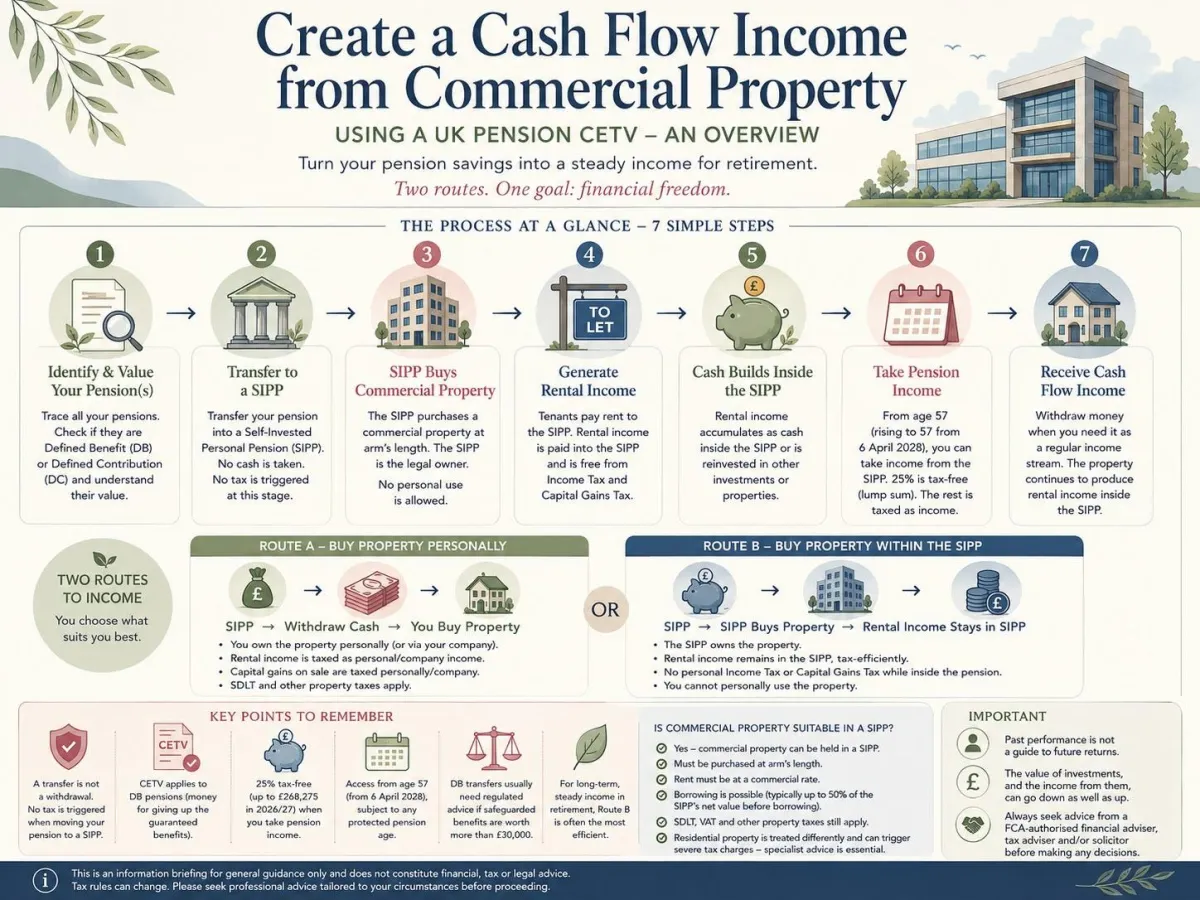
UK Pension → SIPP → Commercial Property
Understanding CETV, pension transfers, SIPP consolidation, crystallisation, cash withdrawal and the routes available for commercial-property investment.
Important: This is information-based analysis only — not personalised financial, tax or legal advice. It is based on the accompanying briefing and its cited UK sources.
The briefing separates five events that are often confused — because they have different tax and regulatory outcomes.
The core distinction: Moving pension rights into a SIPP is normally a pension transfer, not a personal cash withdrawal. A CETV is primarily relevant to DB/safeguarded benefits; it is not spendable cash.
Defined Contribution (DC)
DCTransfer value
A DC pension has a fund value or transfer value. It does not have a CETV in the defined-benefit sense.
What this means in practice
Moving a DC pension into a SIPP normally moves the pension assets between registered schemes without putting the money into your personal bank account.
Defined Benefit (DB)
DBCETV
A DB, final-salary or career-average pension may provide a Cash Equivalent Transfer Value (CETV) showing what the scheme will pay another registered scheme in exchange for giving up the DB promise.
Critical point
Once DB rights have actually been transferred to a SIPP, the DB promise has been exchanged for a DC pension pot. A later transfer of that SIPP is a DC transfer, not a fresh DB CETV.
Route B: SIPP itself acquires the commercial property → rent and sale proceeds remain within the pension wrapper.
2. Five events, five outcomes
Use this as the reference point whenever the terminology becomes confusing.
Event
What it actually is
Tax / regulatory effect
CETV
A DB scheme's quoted value for giving up safeguarded benefits, valid for transfer purposes.
No tax charge. Not cash available to spend. The briefing states a three-month guarantee period.
Pension transfer
Movement of pension rights/assets from one registered scheme to another.
Not an unauthorised payment; the receiving scheme takes responsibility for the rights.
SIPP consolidation
Bringing several pensions together into one SIPP wrapper.
No withdrawal has occurred; assets remain pension assets.
Crystallisation
The point benefits are designated for drawdown, an annuity or a lump sum.
Tests against the Lump Sum Allowance / Lump Sum and Death Benefit Allowance; not triggered by a transfer alone.
Cash withdrawal
Money actually leaving the pension and reaching the member personally.
An authorised payment; the taxable element is added to Income Tax liability for that year.
Worked illustration — DB
A pension promising £20,000 a year has a quoted CETV of £500,000. That £500,000 is not £500,000 of spendable cash; it is the value offered in exchange for giving up the guaranteed income, subject to transfer.
Worked illustration — DC
A workplace pension with a fund value of £180,000 has no DB promise to give up. Moving it to a SIPP is a transfer of the fund/value and the £180,000 remains pension money inside the new wrapper.
3. What happens when a pension moves into a SIPP?
The transfer itself does not put cash in the member's hands.
Statement
Correct?
Pension rights/assets move from the old scheme to the SIPP
Yes
The member remains a pension scheme member throughout
Yes
A DB pension automatically becomes cash
No
The transfer automatically crystallises the pension
No
A CETV is automatically performed on every transfer
No — only relevant where the ceding scheme is DB
Pension rights are exchanged for personal cash
No
DB caveat: transferring a DB pension to a SIPP is normally irreversible. The briefing notes the FCA's expectation that the receiving scheme and receiving investments are assessed as part of the advice.
4. Cash inside a SIPP vs cash withdrawn
This is the dividing line between keeping capital within the pension and making a personal withdrawal.
Cash held inside the SIPP
Cash sitting in the SIPP's dealing/cash account remains pension money. It has not been paid to the member.
Key point
The briefing states that no personal tax charge arises merely from holding cash inside the SIPP pending investment, subject to the provider's own terms.
Cash withdrawn personally
Cash paid from the SIPP into the member's personal bank account is a pension benefit payment. The pension-withdrawal rules apply from that point.
Key point
The intended use of the cash — including buying property — does not itself change the tax treatment of the withdrawal.
5. Two commercial-property routes
These routes can produce very different ownership, tax and control outcomes.
The pension scheme/trustee structure owns the property.
Rent stays inside the pension wrapper while retained there.
No personal pension withdrawal is required to acquire the property.
SDLT applies — there is no blanket pension exemption.
Personal use is generally prohibited or must be on strict commercial terms.
Advantages & disadvantages
Advantage: the investment remains inside the pension wrapper. Disadvantage: you do not personally own or have on-demand access to the property/capital.
6. Route A — pension withdrawal and tax
Key 2026/27 points stated in the source briefing.
Access age
For a standard DC pension, benefits can normally be accessed from the Normal Minimum Pension Age (NMPA), currently 55. The briefing states that NMPA rises to 57 from 6 April 2028, subject to protected pension age rules.
Sources in briefing
HMRC PTM062700 — Protected pension age; HMRC PTM062215 — Right to take benefits before age 57.
Tax-free element
Up to 25% can normally be taken tax-free, subject to the individual's available Lump Sum Allowance (LSA).
Standard 2026/27 LSA: £268,275, subject to prior use and any applicable transitional protections.
Taxable element
The remaining withdrawal is typically taxable income for the year received and sits on top of other income.
England, Wales & Northern Ireland — 2026/27
Basic rate 20%, higher rate 40% and additional rate 45%, after the standard Personal Allowance of £12,570. Scotland has separate Income Tax rates.
PAYE & emergency tax
SIPP providers normally operate PAYE on flexible payments. The first payment can be taxed on an emergency/month-1 basis if HMRC has not supplied the correct tax code, potentially over-deducting tax initially.
National Insurance
The briefing states pension withdrawals are not earnings for Class 1 National Insurance purposes; Income Tax via PAYE is the relevant charge.
Money Purchase Annual Allowance (MPAA)
Certain forms of flexible access can trigger the MPAA and cap future tax-relieved DC contributions at £10,000 for 2026/27.
Important
Not every pension event triggers the MPAA. The specific method of access matters, so this should be checked before withdrawing if further pension contributions are planned.
Large withdrawal example
If someone has £100,000 of other taxable income and withdraws another £200,000 of taxable pension income, the pension amount is added to existing income. It is therefore not all taxed at 20%; a substantial part can fall into higher/additional-rate bands.
7. Route B — SIPP acquires commercial property directly
The property route stays inside the pension structure, subject to the SIPP's rules and pension tax/investment rules.
Commercial property can be held
HMRC pension investment rules contemplate registered pension schemes holding commercial property. The pension scheme/trustee holds legal title rather than the member personally.
Cash-flow principle
Rent flows into the pension. Proceeds from a later sale also stay within the pension wrapper rather than becoming personal income at that point, subject to the pension's tax treatment.
Commercial vs residential
Offices, warehouses, industrial units, shops and other genuinely commercial buildings are the type of property a SIPP can normally hold.
Residential property: the briefing identifies residential property as taxable property for pension purposes and warns of severe tax consequences if held directly or indirectly by an investment-regulated pension scheme.
Connected-party occupation
Where a connected party occupies a SIPP-owned property, rent must be set on a genuinely commercial basis. A below-market arrangement can create an unauthorised-payment charge on the shortfall.
SIPP borrowing
A SIPP can borrow to help fund a purchase, subject to the statutory pension borrowing ceiling.
Briefing limit: up to 50% of the net fund value immediately before borrowing. This is a statutory maximum, not a promise that a lender will provide that amount.
SDLT & VAT
A pension fund does not receive a blanket SDLT exemption. The briefing states that pension-fund purchases are subject to SDLT like other purchases.
Non-residential SDLT example in briefing
For England and Northern Ireland, the briefing gives 0% up to £150,000, 2% on £150,001–£250,000 and 5% above £250,000; a £275,000 commercial property gives £3,250 SDLT. VAT depends on the property and whether an option to tax has been exercised.
8. If the underlying pension is DB
DB transfers require a different process because guaranteed benefits are being surrendered.
Step
What it involves
1. Obtain a CETV
The DB scheme calculates a transfer value based on actuarial assumptions; the briefing states a three-month guarantee period.
2. Compare what is given up vs received
Guaranteed, often inflation-linked lifetime income, plus spouse/dependant benefits, is weighed against an investment-dependent DC pension pot.
3. Regulated advice, if required
Where safeguarded benefits exceed £30,000, the briefing states UK law requires regulated pension-transfer advice before transfer to a DC arrangement can proceed.
4. Advice on the receiving scheme
FCA rules require analysis of the transfer and the receiving scheme/investments, not simply the ceding scheme's numbers.
5. Transfer, if it proceeds
The DB entitlement is replaced by DC pension assets in the SIPP. A later SIPP transfer is a DC transfer, not another DB CETV.
Scam warning: unsolicited approaches, pressure to transfer quickly, cashback/incentives, unclear or high fees, high-risk/unregulated investments, complex/overseas structures, or firms without the correct permissions should be treated as red flags.
9. Consolidated tax & charge reference
Rates and limits reproduced from the source briefing for 2026/27.
Stage / event
Tax or charge
Rate / limit
DC transfer to SIPP
Normally no Income Tax charge for a recognised transfer between registered schemes.
N/A
DB CETV / transfer to SIPP
Normally no immediate Income Tax charge on a recognised transfer; regulated advice cost may apply where required.
N/A
Cash held in SIPP
No personal Income Tax while retained in the pension.
N/A
Tax-free lump sum
0%, within available Lump Sum Allowance.
Up to £268,275 standard for 2026/27
Taxable pension withdrawal
Income Tax added to other income for the year.
20% / 40% / 45% (England, Wales, NI)
Flexible access triggering MPAA
Future DC contribution allowance is capped.
£10,000 (2026/27)
SIPP buys commercial property
SDLT, as for any purchaser.
0% / 2% / 5% non-residential bands
Commercial property rental income
Remains within pension; not personal income while retained in the scheme.
N/A
SIPP borrowing
Statutory ceiling on pension borrowing.
Up to 50% of net fund value pre-borrowing
Unauthorised payment
Unauthorised payment charge, plus surcharge on larger amounts and possible scheme sanction charge.
40%, plus up to 15% surcharge
Qualifying overseas transfer
Overseas transfer charge, subject to exclusions.
25% where charge applies
Residential/taxable property in a SIPP
Severe pension tax consequences; potential unauthorised payment and scheme charges.
Potential charges
10. Route A vs Route B — direct comparison
Use this table to understand the fundamental difference in ownership and control.
Issue
Route A — Withdraw, then buy personally
Route B — SIPP buys the property
Where pension sits afterwards
Reduced by amount withdrawn
Remains fully invested
Who owns property
Member or company personally
Pension scheme/trustee structure
Tax on transfer into SIPP
Normally none
Normally none
Tax on taxable amount used
Income Tax at marginal rate
No personal withdrawal at this stage
Rental income
Personal/company taxable income
Stays within pension wrapper
Capital growth on sale
Personal/company tax rules apply
Generally no personal CGT while held in pension
SDLT
Applies
Applies — no pension exemption
Borrowing
Normal commercial mortgage terms
Capped at 50% of net fund value pre-borrowing
Personal use
Full personal control
Generally prohibited or strict commercial terms
Liquidity
Greater personal flexibility
Subject to pension access rules
Main advantage
Full personal ownership/control
Investment stays inside pension tax wrapper
Main disadvantage
Potentially large Income Tax bill
Loss of personal ownership/direct access to capital
11. Recommended sequence
Do not start by transferring everything into a SIPP before establishing what each existing pension actually is.
2CategoriseSeparate DC from DB/safeguarded benefits.
3Investigate DBBenefits, guarantees, CETV and advice requirements.
4Investigate DCValue, charges, guarantees and protected benefits.
5Assess SIPPConsolidate only where it delivers a real benefit.
6Choose routePersonal purchase, SIPP property or property-related investment.
Phase 1 — Trace & schedule
Build a complete schedule of every pension: provider, type, current value, DB/DC status, safeguarded benefits, retirement age and existing crystallisation.
Phase 2 — Categorise
Separate the schedule into (A) DC pensions and (B) DB/safeguarded-benefit pensions. This split drives most of the subsequent process.
Phase 3 — DB investigation
Confirm benefits and retirement age, identify guarantees, obtain a CETV where appropriate, identify protected tax-free cash and establish whether regulated transfer advice is mandatory.
Phase 4 — DC investigation
Confirm current and transfer values, exit charges, guarantees such as guaranteed annuity rates, protected pension age and protected tax-free cash.
Phase 5 — Decide on SIPP consolidation
Consolidate only where it provides something the existing arrangements do not: broader investment choice, commercial-property capability, consolidated administration or borrowing.
Phase 6 — Choose property route
Choose between Route A, Route B, or a property-related investment held within the SIPP rather than direct ownership.
12. Key risks to check before acting
These are the source briefing's principal warning points.
Do not treat a CETV as spendable cash.
Understand what is being surrendered when transferring DB benefits.
A SIPP transfer is not a withdrawal and does not itself create tax-free cash.
The 25% tax-free figure is bounded by the available Lump Sum Allowance.
A large taxable withdrawal can push income into higher/additional-rate tax.
Check whether the intended withdrawal method triggers the MPAA.
A SIPP-owned property is not personally accessible like a personally owned property.
Guaranteed annuity rate, protected pension age or protected tax-free cash, if any
Personal pension position
Required information
Intended access date
Whether benefits, tax-free cash or drawdown have already been taken
Existing pension protections
Other taxable income in the relevant tax year
Whether further pension contributions are planned
Property
Required information
Freehold or leasehold and purchase price
Existing tenant and expected rent
VAT status and SDLT position
Development/refurbishment required
Intended occupier and borrowing required
Expected holding period
14. Authoritative sources & websites
Open the references only when you need the underlying rule, guidance or practical explanation.
Source hierarchy used by the briefing: HMRC / GOV.UK, FCA, The Pensions Regulator and MoneyHelper (MaPS). The links below are provided as practical navigation points; always check the current page and the relevant scheme/provider rules.
Disclaimer: This is an information-based analysis prepared from published UK regulatory and HMRC guidance current as at 16 August 2026. It is not personalised financial, tax or legal advice and should not be relied on as such. Any transfer of safeguarded/defined-benefit rights should be dealt with by an FCA-authorised pension-transfer specialist, and any SIPP commercial-property structure should be reviewed by a tax adviser or solicitor experienced in SIPP property transactions before funds are committed or a transfer is instructed.
UK Pension Setup & SIPP/SSAS Provider Directory
Provider Directory
UK Pension Setup & SIPP/SSAS Provider Directory
A practical reference for opening a first UK pension from scratch, and for comparing SIPP and SSAS providers — including which ones actually support direct commercial property purchase.
How to use this directory: decide first whether you're building a general pot (Platform SIPPs) or buying commercial property (Property SIPPs / SSAS) — that single decision determines the entire shortlist. Filter by type above, or search by provider name or feature.
Getting started from zero
You don't need an existing pension, or an employer, to open one. Any UK resident under 75 can start a personal pension or SIPP today.
1. Choose a provider
Pick based on what you'll hold in it — a platform SIPP for funds/shares, or a full SIPP/SSAS if commercial property is the goal. Applications are usually online and take 10–15 minutes.
2. Fund it
Pay in a lump sum, set up a regular direct debit, or both. Most providers have a low or no minimum opening amount.
3. Claim your tax relief
Basic-rate relief (20%) is added automatically by the provider. Higher- or additional-rate relief is claimed back through Self Assessment.
4. Choose your investments
Pick your own funds, shares or property, or use a ready-made portfolio if you'd rather not choose individually.
Annual allowance: you can contribute up to 100% of your relevant UK earnings each year, capped at £60,000 for 2026/27. If you pay yourself through a limited company, employer contributions from the company are usually the more tax-efficient route — no National Insurance on them, and they reduce Corporation Tax.
Best-value platform SIPPs
General-purpose SIPPs for funds, shares and ETFs. None of these support direct commercial property — for that, see the Property SIPPs section below.
Vanguard
Platform SIPP
Cheapest option for straightforward index-fund investing, though limited to Vanguard's own fund range.
0.35% p.a. on funds, tiering down at higher account values.
Providers that support commercial property
Direct property purchase needs a "full" or "bespoke" SIPP — a different category from the platform SIPPs above. These providers run in-house property teams that handle valuation, conveyancing panels, connected-party rent checks and SIPP-specific mortgages.
Curtis Banks
Property SIPPAlso SSAS
One of the largest independent SIPP/SSAS providers, with property administration roots dating to 1971 and several thousand SIPP/SSAS-held properties under management.
Over 45 years specialising in SIPP/SSAS commercial property. Well regarded for more complex transactions — geared purchases and syndicated/multi-party deals.
Hands-on property management and trustee services, with over 1,200 commercial properties under administration — often used for bespoke or higher-value transactions.
What actually costs money here: property-specific fees typically run £1,000–£5,000 across purchase and setup, on top of the ongoing SIPP administration fee — noticeably more than a platform SIPP. That's the cost of a provider who will hold legal title, deal directly with the tenant, and police connected-party rent on HMRC's behalf.
What to check before choosing a property provider
Property experience — number of transactions completed, and whether there's an in-house property team.
Acceptable property types — some providers are conservative; others have a broader appetite.
Connected-party policy — how comfortable they are with your own company being the tenant, and what documentation they'll require.
Lender relationships — whether they work smoothly with specialist SIPP mortgage lenders.
Turnaround speed — a slow, conservative provider can cost more in delay than a faster one saves in fees.
SSAS: the director's alternative
If you're a company director, a Small Self-Administered Scheme is worth comparing directly against a SIPP.
How it differs from a SIPP
A SSAS is a very similar wrapper for commercial property purposes — same core HMRC rules on eligible property, connected-party rent and borrowing limits. The difference is who it's built for: a SSAS is set up for a small number of members, typically the directors of the sponsoring company, rather than the general public.
The distinguishing feature
Unlike a SIPP, a SSAS can loan money back to the sponsoring employer (up to statutory limits) — a financing tool some director-owners use alongside, or instead of, property purchase.
Specialists to consider: Talbot & Muir, Curtis Banks and Dentons Pensions (all listed above) each run dedicated SSAS propositions alongside their SIPP business.
Costs compared
Platform SIPPs and property SIPPs sit on very different cost bases — the comparison below is illustrative, not a quote.
Provider
Type
Illustrative annual cost
Commercial property
Vanguard
Platform
≈£75/yr on £50,000
No
Freetrade
Platform
£0/yr (basic plan)
No
interactive investor
Platform
≈£108/yr on £50,000
No
AJ Bell
Platform
≈£125/yr on £50,000
No
Hargreaves Lansdown
Platform
≈£175/yr on £50,000
No
Curtis Banks / James Hay / Talbot & Muir / Dentons / Alltrust / Barnett Waddingham
Full SIPP / SSAS
£1,000–£5,000 property setup, plus ongoing admin fee
Yes
Fees change: several providers revised their pricing within the past year. Always check the current published fee schedule directly with the provider before opening an account.
Before you choose
A short list to work through before applying anywhere.
Check
Why it matters
General pot vs. property
Determines the entire shortlist — platform SIPP or full SIPP/SSAS.
Current fee schedule in writing
Published comparison tables go stale quickly.
Connected-party policy
Ask directly if your own company will be the tenant.
SIPP vs. SSAS, if a director
Get a side-by-side comparison rather than assuming either is automatically right.
FCA authorisation
Verify any provider on the Financial Services Register before applying.
Verification rule: none of this replaces regulated financial advice for your specific circumstances. Confirm any provider's authorisation on the FCA Financial Services Register before opening an account or transferring funds.
No matching providers found. Try another keyword or remove the filter.