UK Property, City Planning & Wellness: Consolidated Research Briefing
Nature × Space × Human Biology

UK property, city planning & wellness.

A Synthesis of Individual, Community, and Systems-Level Interventions

Research Sections / Expand to Explore
011. Executive Overview: Housing as a Social Determinant of Health+

Housing is a foundational determinant of health. The quality, affordability, safety, and design of housing shape physical and mental health throughout the life course and are among the primary drivers of health inequalities in England. Approximately 60% of health outcomes are shaped by environmental, social, and economic conditions, many of which are directly influenced by urban and spatial planning.

The built environment plays a significant role in shaping the social determinants of health — planning decisions affect air quality, housing standards, green space accessibility, and urban design. However, the distribution of these health outcomes is not equal. Socio-economic deprivation and ethnic inequalities are closely linked to poorer health outcomes, with people in more deprived areas experiencing a gap in healthy life expectancy of up to 20 years.

022. Core Problems Affecting Wellbeing+

2.1 Housing Quality & Physical/Mental Health

A comprehensive academic literature review identified nearly 200 health-influencing features or pathways, including architectural design, climate change, community infrastructure, natural environments, neighbourhood socio-economic characteristics, and transport features.

Key statistics:

- One in five homes in England fails to meet the Decent Homes Standard.

- The NHS spends an estimated £1.4 billion annually treating those affected by substandard housing.

- There is low-to-moderate certainty evidence that housing precarity and overcrowding are associated with poorer mental health outcomes.

- One study found an association between poor housing quality and changes to individual DNA.

- 3.5 million homes in England are non-decent, with 7.5 million people of all ages living in them.

- Among those aged 55+, 36% of homeowners in non-decent homes report high or very high anxiety, rising to 47% in the social rented sector.

Critical hazards:

- Damp and mould: Predominantly impact airways and lungs; can cause serious illness and death. Also affect mental health through unpleasant living conditions, destruction of property, anxiety about physical health impacts, and social isolation (not wanting visitors in the home).

- Cold homes: Temperatures below 18°C are associated with increased risks of cardiovascular events, respiratory conditions, falls, and suppressed immune function. Mental health impacts include increased risk of depression and anxiety, and greater likelihood of social isolation.

- Overcrowding: Over 310,000 children in England are forced to share beds. One in six children lives in cramped conditions. Overcrowding leads to a "relentless daily struggle," with children unable to find space for homework, play, or privacy. Linked to boredom, aggressive behaviour, anxiety, depression, self-harm, and suicidal ideation.

2.2 Housing Affordability & Psychological Distress

The housing affordability crisis has a pronounced impact on mental health.

Key statistics:

- Over 5 million UK adults are experiencing a "triple whammy" of financial, health, and housing insecurity — a level of "multiple stress" unseen since the global financial crisis.

- They are at least twice as likely as the general population to report psychological distress, insomnia, and social isolation.

- Generation Rent — young people in the private rented sector due to high house prices — are suffering severe negative mental health impacts.

- In cities like Oxford, average rents can absorb over 60% of individual income.

- A 2025 study found that 52% of English housing cost-payers entered the new year worried about housing or financial pressures.

- 71% of those facing housing problems reported feeling anxious; 49% reported feeling despair.

- Shelter reports that 1 in 5 renters in England have experienced mental health issues due to housing problems in the last five years.

2.3 Tenure Insecurity in the Private Rented Sector (PRS)

Private renters experience the steepest increases in mental distress in the UK. Research from the Bennett School of Public Policy at Cambridge highlights that private renters lack "ontological security" — the sense of stability and continuity that a home provides. The threat of "no fault" evictions under Section 21 creates chronic uncertainty.

- Citizens Advice reports that half of all renters affected by disrepair experience stress or anxiety, and 22% suffer from depression as a result.

- The PRS has the highest proportion of non-decent properties (21% in 2022–23, approximately 1 million homes), worse than owner-occupied (14%) and social rented (10%) sectors.

2.4 Housing Insecurity & Temporary Accommodation

Housing insecurity — encompassing eviction threats, temporary accommodation, and frequent moves — has a profound impact on children and young people. A major NIHR systematic review identified mental health problems (anxiety, depression, self-harm, suicidal thoughts), physical health problems (asthma, eczema, infectious diseases), and developmental delays as direct outcomes.

- In London alone, over 75,000 children under 18 are homeless and living in temporary accommodation.

- The UCL Institute of Health Equity (Marmot Review) warns this "blights children's future permanently," impairing lung development, educational attainment, and long-term employment prospects.

2.5 Lack of Supported Housing for Mental Health Recovery

A critical gap exists between hospital discharge and community living.

- A 2026 report by the Royal College of Psychiatrists, Look Ahead, and the National Housing Federation found that a lack of supported housing led to 121,695 additional hospital bed days in 2024/25, costing NHS mental health services £102 million.

- Over 95% of urgent mental health beds are occupied, far exceeding the safe 85% threshold.

- NHS England spent over £1.4 billion on private mental health beds between 2019–2024 to compensate for the supported housing shortfall.

2.6 Community Design & Social Isolation

Urban design directly influences social connection and loneliness.

- Many new neighbourhoods lack essential infrastructure for healthy, fulfilling, and independent lives — creating places that cement car dependency and social isolation.

- By 2026, it is projected that 2 million people will experience regular loneliness.

- Poorly designed high-density housing, lack of communal spaces, and rundown conditions can discourage socialising and increase loneliness.

- Green space: A systematic review of UK residential green space found associations with improved mental health, reduced chronic disease risk, and a stronger "equity-promoting effect" among vulnerable groups. Better green space access shows a weak association with lower incidence of anxiety and depression.

- Community-Led Housing (CLH): Participants are significantly less likely to feel lonely than those in traditional housing. CLH fosters social cohesion, belonging, and alleviates various forms of loneliness.

2.7 Structural Challenges in the Planning System

Although the 2010 Marmot Review highlighted planning as a lever to influence social determinants of health, health inequalities have widened since then.

- Local planning authorities face severe funding cuts and loss of professional expertise.

- The plan-led system has been weakened by the decline of strategic planning.

- 85% of JSNAs now cover cold homes and fuel poverty, and 77% cover housing affordability, but coverage of overheating (7%) and indoor air quality (16%) remains poor.

- Fewer than half of joint local Health and Wellbeing Strategies contain explicit actions, implementation mechanisms, or measurable housing-related outcomes.

- Barriers between planning, public health, housing, and health teams persist, including different working cultures, jargon, and lack of expertise in health-informed placemaking.

033. Key Statistics — Housing & Mental Health in the UK+
IssueStatisticSource Context
Non-decent homes3.5 million homes in England; 7.5 million people affectedAgeing Better State of Ageing 2025
Anxiety in non-decent homes (55+)36% homeowners; 47% social renters report high/very high anxietyAgeing Better State of Ageing 2025
Children in overcrowded housing310,000+ children forced to share beds; 1 in 6 lives in cramped conditionsNational Housing Federation 2023
PRS non-decent properties21% (approx. 1 million homes)English Housing Survey 2022–23
Renters with mental health issues from housing1 in 5 in the last 5 yearsShelter
Renters with stress/anxiety from disrepair50% of those affectedCitizens Advice
Renters with depression from disrepair22% of those affectedCitizens Advice
Children in temporary accommodation (London)Over 75,000 under 18UCL Institute of Health Equity
Supported housing bed days lost121,695 additional bed days in 2024/25; cost £102 millionRoyal College of Psychiatrists / Look Ahead / NHF 2026
Urgent mental health bed occupancyOver 95% (safe threshold: 85%)Royal College of Psychiatrists
NHS spend on private mental health beds (2019–2024)Over £1.4 billionRoyal College of Psychiatrists
Adults in "triple whammy" insecurityOver 5 millionMultiple sources
Housing cost-payers worried (2025)52%2025 study
Facing housing problems: anxious71%2025 study
Facing housing problems: despair49%2025 study
Projected regular loneliness by 20262 million peopleMultiple sources
Consumers prioritising wellness in home features60% (up 17% from 2 years prior)Wellness real estate market data
ESG social value uplift5% market value increaseSocial Market Foundation
Healthy New Towns SROI (Kidlington)£18 wellbeing benefit per £1 investedNHS England evaluation
Warm homes annual savingsUp to £4 billionHealth and social care system
Social housing NHS savings£19 billion annually (4.2 million homes)NHS England
Excess cold reduction savings£848 million annuallyNHS England
Warming vulnerable homes ROI£4 health benefit per £1 spentPublic health economics
1.5 million homes social value£103 billion potential social impactIndustry framework estimate
Lambeth IPSA savings£2.5 million since 2015Joint commissioning evaluation
Aviary House net saving£71,000 in 2017/18Solihull Metropolitan Borough Council
Aviary House wellbeing improvement52% improvement reported by residentsSolihull evaluation
Hope Gardens positive move rate74% move to more independent housingSt Mungo's / Hammersmith & Fulham
044. Public Sector & Statutory Responses+

4.1 Legislative & Regulatory Reforms

Awaab's Law (Social Housing)

Named after Awaab Ishak, who died from mould exposure, this law (effective from October 2025) mandates strict timeframes for social landlords to investigate and repair damp and mould hazards. Phase 1 requires emergency hazards to be made safe within 24 hours, and significant damp/mould hazards to be addressed within specified timeframes. The government is committed to extending this to the private rented sector.

The New Decent Homes Standard (2026)

A reformed standard, applying to both social and private rented sectors from 2035, introduces a new Criterion E: "A home should be free of damp and mould." It requires landlords to take proactive prevention measures, not just reactive repairs. The standard also addresses thermal comfort, falls hazards, and overcrowding.

Renters' Rights Bill

Proposes abolishing Section 21 "no fault" evictions, introducing periodic tenancies, and creating a private rented property portal. The government's impact assessment explicitly links these reforms to mental health benefits, noting that "tenants are typically more distressed on mental health indicators than homeowners" and that pet ownership provisions can help combat loneliness.

Healthy Homes Guidance (July 2026)

Published by MHCLG, this sets "core requirements" and "good practice enhancements" for new homes across four pillars: Inclusivity (accessibility to M4(2) minimum), Comfort (noise mitigation, thermal performance), Safety (air quality, water quality), and Resilience (climate adaptation). It aims to ensure homes support "healthier and resilient communities."

Building Regulations Updates

- Part O (2021): Requires new buildings to mitigate overheating risks.

- Part E: Addresses sound insulation.

- Critics note that even compliant homes still fail to address key factors in respiratory disease, mental health decline, and sleep disruption.

Amendment 226 to the Planning and Infrastructure Act 2025

Sought to create a duty for the Secretary of State to promote a regulatory framework for "healthy homes and neighbourhoods," explicitly targeting physical, mental, and social health.

4.2 Legislative & Policy Timeline

Policy/RegulationEffective DateKey Wellness Provision
Awaab's Law (Phase 1)October 2025Strict timeframes for damp/mould repair in social housing; 24-hour emergency response
Healthy Homes GuidanceJuly 2026Core requirements for inclusivity, comfort, safety, resilience in new homes
New Decent Homes Standard2035 (full application)Criterion E: homes free of damp and mould; proactive prevention required
Renters' Rights BillPendingAbolition of Section 21; periodic tenancies; pet ownership provisions
Building Regulations Part O2021Overheating mitigation in new builds
Building Regulations Part ECurrentSound insulation standards

4.3 Health & Planning Integration

Joint Strategic Needs Assessments (JSNAs)

Since the Health and Social Care Act 2012, local councils and health partners must prepare JSNAs and Joint Health and Wellbeing Strategies. A 2026 government review found that 85% of JSNAs now cover cold homes and fuel poverty, and 77% cover housing affordability.

Spatial Planning for Health Specialists

Some councils, such as Southampton City Council, have created dedicated roles to bridge public health and planning teams. These specialists integrate health considerations into local planning policies, rewrite development management policies, and ensure Health Impact Assessments are conducted for major projects.

Healthy New Towns & Active Design

NHS England's Healthy New Towns Programme (launched 2015) aimed to create "healthy places." Evaluations show that walkability, mixed-use centres, early community services, and strong governance consistently improve health, wellbeing, and long-term economic outcomes. Green corridors, pocket parks, and water-sensitive design directly improve wellbeing and reduce inequalities. In Kidlington, an interactive wayfinding project's Social Return on Investment evaluation found that every £1 invested generated £18 in wellbeing benefits.

Sport England's 10 Active Design Principles and Public Health England's spatial planning guidance promote walkable communities, green infrastructure, and mixed-use developments.

4.4 Local Authority & NHS Integration

Data Linking (EPCs to Mental Health)

Research linking housing energy efficiency certificates (EPCs) with clinical mental health data at the LSOA level across England has revealed statistically significant relationships between home energy efficiency and depression prevalence, enabling councils to identify where additional mental health services or preventative housing measures are most needed.

Integrated Personalised Support Alliances (IPSAs)

A model of joint commissioning between councils, CCGs, NHS trusts, and voluntary sector providers. In Lambeth, the IPSA partnership (Lambeth Council, SLaM NHS Trust, Certitude, and Thames Reach) has saved almost £2.5 million since 2015 by finding alternatives to inpatient and residential care through community-based supported accommodation. Over a third of the original 200-person cohort moved to more appropriate housing.

Psychologically Informed Environments (PIE)

Hope Gardens, a 27-bed scheme in West London run by St Mungo's and commissioned by Hammersmith and Fulham Council, was refurbished using PIE principles. The scheme includes private lockable rooms, female-only safe spaces, flexible support for couples, and spacious communal areas decorated with resident input. 74% of residents make a positive move to more independent housing when they leave, higher than the organisational average.

Step Up Step Down (SUSD) Services

Aviary House in North Solihull, run by Home Group and commissioned by Solihull Metropolitan Borough Council, accommodates adults with severe mental health needs and includes four SUSD beds funded by the NHS. The model reduced hospital admissions and delivered a net saving of £71,000 in 2017/18, with individuals reporting a 52% improvement in wellbeing after their stay.

4.5 Targeted Local Interventions

Jaywick Sands Healthy Homes Team (JSHHT)

A partnership between the local council and the NHS that proactively identifies tenants living in poor-quality housing and connects them with health and support services. Shortlisted for a national award for effectiveness in improving residents' physical and psychological health.

Cheshire and Merseyside Health and Housing Partnership (CMHHP)

Launched January 2025. This collaboration integrates housing, health, and social care to tackle issues like substandard housing's impact on respiratory illness and to provide specialised housing solutions for individuals with severe mental illness. Aims to reduce hospital admissions and address health inequalities at their root.

4.6 Supported Living & Rehabilitation Services

Recent public-private partnerships creating supported living environments:

- Saxon House (Bury): Supported living service providing housing and tailored mental health support for up to 13 people stepping down from hospital care.

- Inspiring Minds East (Burnley): Rehabilitation service offering nine self-contained flats with 24/7 support for adults with mental health diagnoses.

- The Stewarts (Harpenden): New accommodation supporting residents with mental health issues as they leave hospital.

4.7 Social Prescribing & Green Health

The NHS and local authorities are expanding social prescribing to address housing-related mental health issues. Interventions include DIY classes (building pride in the home), budgeting advice, allotments and green social prescribing, and community supermarkets.

The Standing Together Cymru project, curated by the Mental Health Foundation, provides group activities within supported housing settings to tackle isolation and improve wellbeing.

4.8 Housing Association & Registered Provider Initiatives

Change Mental Health & Kingdom Housing Association

Change Mental Health has partnered with Kingdom Housing Association in Scotland to embed Mental Health Support Workers within housing association tenancy support services, offering trauma-informed, non-clinical support to tenants at risk of tenancy breakdown or crisis.

Making Every Contact Count (MECC)

Adopted by housing providers as an approach to behaviour change. Uses day-to-day interactions between housing staff and residents to support positive changes to physical and mental health. Evidence shows residents reporting improved confidence, independence, and mental health through these brief opportunistic conversations.

Clarion Housing Group's "Resident of the Future" Report

Uses demographic shifts to project who residents might be in the near future and the growing challenges they are likely to face, including loneliness and mental health.

055. Private Sector & Corporate Responses+

5.1 Property Developers & ESG Integration

The real estate industry is increasingly recognising that maximising social value can lead to a 5% uplift in the market value of an asset, according to the Social Market Foundation.

Developers and investors are prioritising ESG (Environmental, Social, and Governance) factors, with tenants demanding higher standards for air quality, water quality, natural light, access to green spaces, and cycling facilities.

Avison Young has established a dedicated ESG and Wellness strategy delivered through professionals, services, online training, and a Global Citizenship Affinity Group, working to "effect change through ESG and Wellness at a human scale to help create healthy, productive, prosperous spaces and places."

5.2 Wellness Real Estate & Neuro-Architecture

A fundamental market shift is underway: 60% of consumers cite health and wellness as the number one reason they desire certain home features, up 17% from two years prior. Developers are responding with "brain-friendly buildings" that integrate biophilic design, circadian lighting, and sensory-calibrated spaces.

The Spine in Liverpool, with the Royal College of Physicians as its anchor tenant, showcases innovations including light-adaptive workspaces, integrated greenery for air quality, and mindfulness zones to reduce stress.

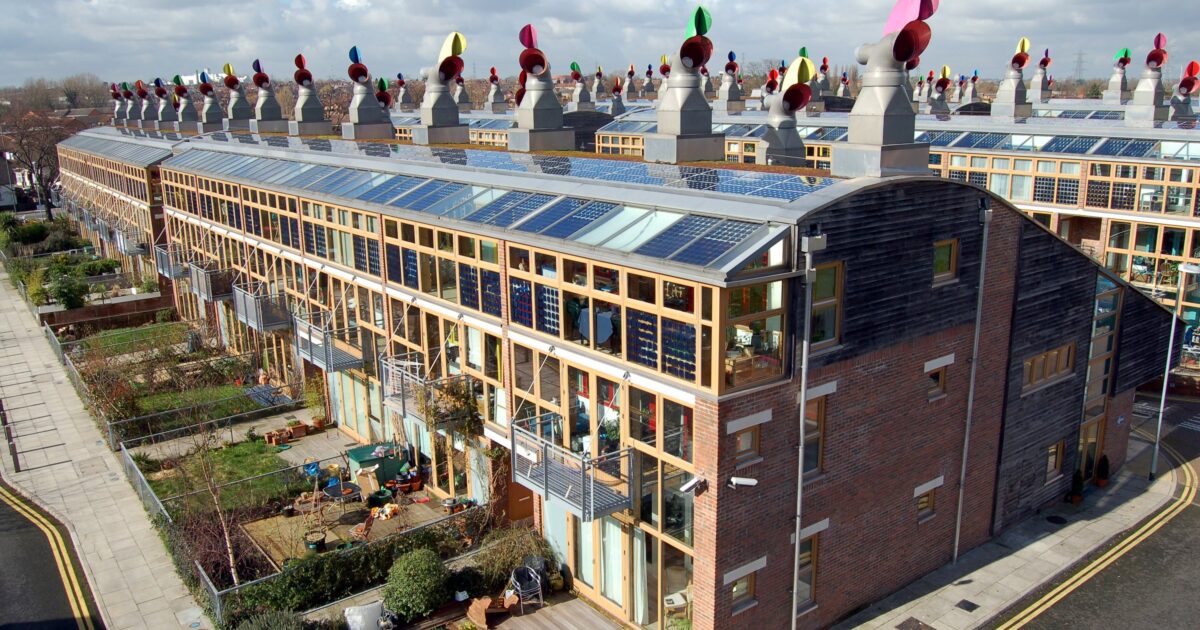
BedZED (Beddington Zero Energy Development) in London, developed by BioRegional, is described as "probably the first large net zero development in the UK," featuring 100 homes where residents can see green spaces, hear wildlife, and experience nature as integral to daily life. The residents' association continues to plant and nurture the surrounding environment.

The Round (London): A £2 billion "wellness village" designed by Foster + Partners, aiming to be the UK's first high-rise to achieve the WELL Community Gold Standard. It will include hot and cold therapy rooms, napping pods, and art therapy to address social isolation and anxiety.

City Sanctuary: An SME developer became the first in the UK to receive the official Residential WELL Seal for a retrofit project, achieved by focusing on air quality, light, and water filtration.

5.3 PropTech & Smart Home Health Monitoring

The private sector is deploying ambient sensing technologies for health and wellbeing surveillance in homes. These include passive infrared motion sensors, temperature and humidity monitors, light sensors, and pressure pads that can detect falls, monitor sleep quality, track gait speed, and identify hazardous activities — without the intrusiveness of wearables.

Research confirms these technologies can decrease fall risks, improve working memory, increase physical activity, enhance safety and security, and support assisted daily living — particularly for older adults in sheltered housing, extra-care housing, and care homes.

5.4 "Sentient Neighbourhoods" & AI-Driven Wellness

Developers are scaling AI-integrated wellness beyond individual units to the neighbourhood level. Connected platforms are using data to personalise community programming, facilitate social connectivity, and activate shared wellness experiences — identifying which fitness classes, social gatherings, or wellness resources residents engage with and adapting offerings in real time.

5.5 Workplace & Employee Wellness

The private sector is also focusing on the wellness of its workforce.

- Bellway has introduced 'wellness zones' on its construction sites, featuring picnic benches and posters promoting mental health support.

- A Homes England-backed scheme allows housebuilders to unlock cheaper finance by donating to a construction mental health charity, incentivising them to care for their workers' wellbeing.

5.6 Developer-Wellness Company Partnerships

Moda and Hero Partnership: Developer Moda has partnered with wellness company Hero to create "the UK's healthiest rental communities." This includes providing mental health first aid training to on-site staff and integrating fitness and wellness technology into the resident experience.

066. Community-Led & Individual Responses+

6.1 Community-Led Housing (CLH)

Community-Led Housing — encompassing community land trusts (CLTs), cohousing, cooperatives, and self-build housing — is growing in London and across the UK. A systematic review demonstrates that CLH has positive impacts on individual health outcomes and neighbourhood-level factors that affect health.

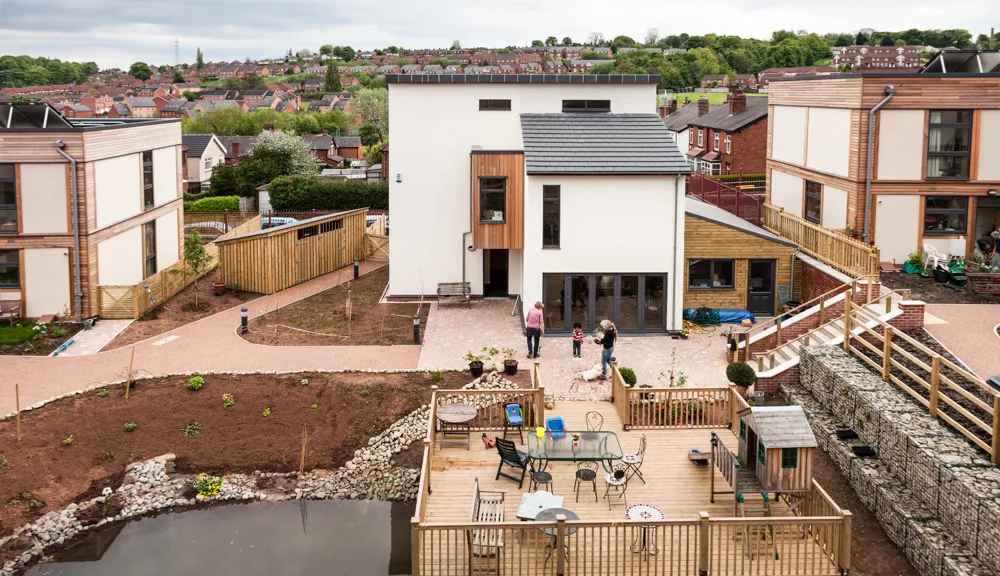
Church Grove Community Land Trust (Lewisham, completed 2024): Contains 36 homes with shared ownership, affordable rent, and social rent tenures. Includes a communal laundry, workspace, guest suite, public river access, communal food growing facilities, and a publicly accessible community space. Some residents were involved in construction, gaining new skills. The building is raised a metre off the ground to mitigate flood risk, with planters creating a green screen to reduce overheating and air pollution.

Hazelmead Cohousing (Dorset): The UK's largest cohousing development, with 53 affordable homes. Resident-led design prioritises intergenerational living, social interaction, and community support to combat loneliness. Uses a sociocratic governance model for transparent decision-making.

LILAC Cohousing (Leeds): Evaluation showed huge increases in residents talking with neighbours, borrowing things, exchanging favours, and feeling a sense of belonging.

Melfield Gardens (Lewisham): An intergenerational housing scheme bringing together students and older adults to build community ties.

Research shows cohousing decreases isolation in seniors, positively impacts quality of life, and benefits physical and mental health through mechanisms of social support, sense of community, and sense of security.

6.2 Community Land Trusts & Mental Health

CLTs provide housing stability that directly improves mental health. Research with CLT residents found that the stability of CLT housing improves the mental health of lower-income homeowners by reducing the chronic stress and anxiety associated with housing insecurity. One resident described the shift from rental precarity: "It is always a thing that at any moment, you could lose your housing... the stress that working class and poor families have is a constant low burn... And to me, that's a really huge component."

CLTs also offer health-promoting services beyond housing, including homeownership counselling, financial literacy education, foreclosure prevention, and during COVID-19, outreach regarding testing, vaccination, and transportation to medical appointments. Some CLTs even employ part-time social workers.

6.3 Tenant Empowerment & Collective Action

Individuals and tenant groups are increasingly organising to claim their rights. Tenant associations are forming to:

- Educate members about housing rights and disrepair claims

- Empower residents to challenge negligent landlords

- Escalate pressure on decision-makers through collective action

- Evaluate outcomes and build sustained bargaining power

Citizens UK's 'Homes for Health': Supports tenant action teams to build knowledge about housing rights. Members like Helen, who was hospitalised due to damp and mould, have found empowerment and improved mental health through collective action.

Legal firms are supporting tenants to claim compensation for housing disrepair that has caused psychological harm. UK courts recognise conditions including generalised anxiety disorder, clinical depression, PTSD, insomnia, and adjustment disorder as compensable harms when caused or worsened by landlord neglect.

6.4 Individual & Household Adaptations

At the individual level, people are:

- Improving home environments independently: DIY improvements, mould prevention measures, and thermal upgrades

- Using technology: Smart thermostats, air quality monitors, and dehumidifiers to manage indoor conditions

- Seeking social connection through design: Creating "third spaces" within homes, participating in community gardens, and using shared workspaces

- Engaging with social prescribing: Attending community cafes, volunteering, and participating in local activities to combat isolation

Michaela's Story: A Habinteg resident who struggled with severe depression credits a voluntary litter-picking scheme with transforming her life. The activity provided a positive routine and helped her reconnect with her community.

077. Third Sector & Charity-Led Initiatives+

7.1 Supported Housing & Discharge Services

Look Ahead provides mental health hospital discharge services, demonstrating that "when supported housing is available, people recover faster, avoid relapse and don't cycle back through inpatient care." The Royal College of Psychiatrists is calling for long-term, sustainable funding for supported housing as "core mental health infrastructure."

7.2 Loneliness & Built Environment Campaigns

The Campaign to End Loneliness and the Housing LIN advocate for built environment changes including intergenerational living, well-located communal spaces, proximity to green and blue spaces, and "sociable housing policy" that designs multi-unit buildings with shared spaces supporting neighbourly connection.

The Agile Ageing Alliance has published "Cultivating Neighbourhoods that Care: A Manifesto for change," urging the housing sector to combat loneliness through more inventive and inclusive places.

7.3 Research & Advocacy

UCL's Bartlett School is conducting participatory action research with children and young people in Community-Led Housing in London, using "crafting room boxes" to elicit deep, tacit knowledge about home and place that is often left out of policy recommendations.

The London Assembly Housing Committee (2025) has called for expanding cooperative housing and community land trusts, noting that residents develop "strong local connections, which help to combat loneliness and improves mental health and wellbeing," alongside practical skills in project management, community organising, and construction.

088. Assessment & Decision-Making Tools+

8.1 Assessment & Evaluation Tools

ToolDeveloper / SponsorApplicationWellness Focus
HAUS ModelTRUUD university consortium / MHCLGUrban systems appraisalConditions inside and around homes; intervention guidance
Health Impact Assessment (HIA)Various local planning authoritiesDevelopment screeningMaximising health and wellbeing benefits
Social Value FrameworkIndustry consortiumHousing impact assessmentWellbeing, economic resilience, public services
WELL Building StandardInternational WELL Building InstituteBuilding certificationAir, water, light, nourishment, thermal comfort, movement, materials, mind, community, innovation
Residential WELL SealInternational WELL Building InstituteRetrofit certificationHealth-focused design verification

8.2 The HAUS Model (Health Appraisal of Urban Systems)

Developed by the TRUUD university consortium and incorporated into MHCLG's evaluation guidance. Considers conditions inside and immediately around the home, guiding decision-makers on intervention types that deliver better health outcomes. Demonstrates how well-designed homes and places can reduce the health costs of disease.

8.3 Health Impact Assessment (HIA)

An increasing number of local planning authorities require developments to demonstrate how they support and maximise health and wellbeing benefits, including conducting HIA screenings.

8.4 Social Value Assessment Frameworks

The industry has developed the UK's first framework for assessing the impact of housing on wellbeing, economic resilience, and public services. It is estimated that if 1.5 million new homes are delivered in England, this could unlock £103 billion in social impact value.

099. Economic Arguments & Return on Investment+

- Investing in warm, energy-efficient homes could save the health and social care system up to £4 billion annually.

- Every £1 spent on warming the homes of vulnerable people generates £4 in health benefits.

- England's 4.2 million social homes save the NHS £19 billion annually by improving physical and mental health and reducing GP and A&E attendances.

- Reducing excess winter cold in homes could save the NHS £848 million annually.

1010. Exemplary Projects — Typology & Outcomes+
ProjectLocationTypeKey Wellness FeatureDocumented Outcome
Hope GardensWest LondonPIE-supported housingLockable rooms, female-safe spaces, resident-decorated communal areas74% positive move to independence
Aviary HouseNorth SolihullSUSD service24/7 support, NHS-funded step-down beds52% wellbeing improvement; £71k net saving
Church Grove CLTLewishamCommunity Land TrustCommunal laundry, workspace, guest suite, food growing, flood-resilient designResident skill-building; reduced overheating/air pollution
Hazelmead CohousingDorsetCohousing (53 homes)Sociocratic governance, intergenerational design, affordable homesReduced loneliness; high social interaction
LILAC CohousingLeedsCohousingMutual support, shared facilities, resident controlIncreased neighbour interaction; strong belonging
BedZEDLondonNet-zero eco-village100 homes integrated with nature, wildlife, green spaceLong-term resident environmental stewardship
The SpineLiverpoolWellness office/anchorLight-adaptive workspaces, biophilic air quality, mindfulness zonesStress reduction; neuro-architecture showcase
The RoundLondonWellness high-rise (£2bn)WELL Community Gold Standard, therapy rooms, napping pods, art therapySocial isolation and anxiety intervention
Jaywick Sands Healthy Homes TeamJaywick SandsCouncil-NHS partnershipProactive tenant identification, health-service connectionNational award shortlist; improved physical/psychological health
CMHHPCheshire & MerseysideStrategic partnershipHousing-health-social care integrationReduced hospital admissions; health inequality targeting
1111. Actor Mapping — Who Is Doing What+
ActorKey ActionsWellness Outcomes Targeted
Local Authorities / NHSJoint commissioning (IPSAs), PIE refurbishment, data linking (EPCs to mental health), social prescribingHospital avoidance, tenancy stability, targeted mental health services
Housing AssociationsEmbedded mental health workers, MECC training, future needs research, supported housingTenancy sustainment, resident confidence, crisis prevention
Private DevelopersESG integration, wellness real estate, biophilic design, neuro-architecture, smart neighbourhoodsMarket differentiation, resident satisfaction, healthspan extension
PropTech CompaniesAmbient health sensors, AI-driven community platforms, fall detection, sleep monitoringSafety, independence, early intervention
Community Land Trusts / Co-housingResident-controlled housing, communal facilities, democratic governance, skill-buildingHousing security, social connection, reduced loneliness, empowerment
Tenant Groups / IndividualsCollective organising, legal claims for disrepair, home adaptations, community participationRights enforcement, compensation, individual resilience
Charities / Third SectorDischarge services, loneliness campaigns, intergenerational living advocacy, participatory researchSystemic advocacy, policy influence, filling service gaps
1212. Persistent Gaps & Challenges+

Despite these initiatives, several systemic barriers remain:

12.1 Persistent Systemic Gaps

GapImpact on WellnessCurrent Status
Enforcement capacityPoor conditions persist uncheckedEnvironmental health teams understaffed
Funding shortfallsPrevention abandoned for "firefighting"Council budgets reduced; short-term grants dominate
Cross-sector coordinationHealth, planning, housing operate in silosDifferent cultures, jargon, expertise gaps
Supported housing supplyHospital readmission cycles continueGap widening; 95%+ bed occupancy
Private sector lagPRS renters remain exposedAwaab's Law social-only until extended; Renters' Rights Bill pending
Scale of exemplary projectsMillions still in non-decent homesSmall number of model projects vs. 3.5m non-decent homes
Market segmentationWellness design concentrated at luxury end"Great Rebalance" to attainable price points still emerging

12.2 Detailed Gap Analysis

- Enforcement capacity: Local authority environmental health teams are understaffed, limiting the ability to enforce housing standards.

- Funding shortfalls: Council budgets have been reduced, forcing a shift from long-term prevention to "firefighting." Competitive, short-term grant funding undermines strategic planning.

- Cross-sector coordination: Barriers between planning, public health, housing, and health teams persist, including different working cultures, jargon, and lack of expertise in health-informed placemaking.

- Supported housing supply: The gap between available supported housing and demand is widening.

- Private sector lag: While social housing is subject to Awaab's Law and the new Decent Homes Standard, private renters remain more exposed to poor conditions and insecurity until the Renters' Rights Bill and extended regulations take full effect.

- Scale: Exemplary projects exist but remain relatively small compared to the 3.5 million non-decent homes and millions experiencing housing-related mental distress across the UK.

- Market segmentation: The private sector is responding to market signals but primarily at the luxury end. The "Great Rebalance" — bringing wellness design to attainable price points — remains an emerging opportunity rather than a realised norm.

1314. Deep-Dive: Community Websites, Financing & Construction Specifics+

14.1 Project-by-Project Detail

Hope Gardens — West London

Hope Gardens, West London — PIE-supported housing in the former Shepherd's Bush Empire building

Community Website: None found (operated by Centrepoint as part of their supported housing portfolio)

Community Schemes Implemented:

- Psychologically Informed Environment (PIE) — the physical environment itself is designed as a "secure base" for trauma recovery

- Resident-decorated communal areas — co-production model where residents shape their own spaces

- Female-safe spaces — gender-specific security protocols

Financial Scheme:

- Operated by Centrepoint (charity) as part of their supported housing portfolio

- Funded through supported housing revenue (Housing Benefit + local authority commissioning)

- No specific grant funding identified beyond standard supported housing revenue streams

Design/Construction Details:

- Lockable private rooms — critical for trauma-informed design

- Communal areas designed for gradual independence (74% positive move-on rate)

- No specific construction system identified; standard refurbishment approach

Aviary House — North Solihull

Aviary House, North Solihull — 28-apartment SUSD mental health supported living

Community Website: None dedicated; managed by Home Group

Community Schemes Implemented:

- Step Up Step Down (SUSD) service — 4 NHS-funded step-down beds for crisis recovery

- Peer support network — recovered clients return to volunteer within the scheme

- Community integration — links with Smith's Wood primary school and village centre facilities

Financial Scheme:

- European Regional Development Fund (ERDF) + Homes and Communities Agency — part of ~£20m village centre regeneration

- NHS Birmingham and Solihull Mental Health Trust — funds the 4 step-down beds

- Solihull Metropolitan Borough Council — commissions the supported living service

- Net saving of £71,000 in 2017/18 through reduced hospital admissions and out-of-area placements

Design/Construction Details:

- Self-contained flats with 24/7 on-site staff

- Located at the heart of Smith's Wood Village Centre — integrated with Spar, Post Office, primary school, and planned health centre

- New-build as part of a wider regeneration replacing two demolished tower blocks

Church Grove CLT — Lewisham

Church Grove, Lewisham — RUSS community-led self-build housing (36 homes)

Community Website: www.theruss.org — Rural Urban Synthesis Society (RUSS)

Community Schemes Implemented:

- Self-build training programme — residents completed plumbing and internal finishes; 16 self-builders, 8 households fitted out empty shells

- RUSS School of Community Led Housing — workshops passing knowledge to other groups

- Community Hub — crowdfunded self-build community space built by 90 volunteers, using reclaimed windows and flooring from a Walter Segal exhibition

- Open membership — £1 share = 1 vote; ~1,200 members, 40 active volunteers

Financial Scheme:

- GLA early-stage grant — feasibility and consultant funding

- CAF Venturesome loan — planning permission costs

- Triodos Corporate Finance — financial modelling and viability

- GLA capital grant + social investor/bank loans — construction finance

- CDS Co-operatives partnership — CDS purchased rented flats as Registered Provider landlord

- Parity Trust — assessed residents' affordability for shared equity/shared ownership

- Resale prices decoupled from market — linked to inflation, not property values

- 250-year lease from Lewisham Council for £1 — land value removed from affordability equation

Design/Construction Details:

- Originally designed as PassivHaus by Architype; revised by SEH Architects due to budget and fire safety concerns (timber frame replaced with concrete frame + alternative cladding)

- Solar-powered heat pump arrangement for hot water

- External walkways with shared and private gardens — encourages neighbour interaction

- Homes 10% larger than London area standards

- Two blocks linked by a bridge — flood-resilient design on former school site

- Construction: 2021–2023 (just over 2 years)

Hazelmead Cohousing — Dorset

Hazelmead, Bridport — UK's largest cohousing development (53 homes)

Community Website: Bridport Cohousing (via BCHA)

Community Schemes Implemented:

- Sociocratic governance — consent-based decision making; mantra: "good enough for now, safe enough to try"

- Move-in integration support — structured onboarding for new residents

- Community microgrid — PV array + onsite battery managed by CLT energy supply company

- Common house self-build — residents building final community building using timber frame, straw bales, and clay render

Financial Scheme:

- Community Land Trust (CLT) — land and 20% equity retained permanently

- Bournemouth Churches Housing Association (BCHA) — housing association partner

- 26 homes for social rent + remainder for shared ownership at up to 80% market value

- 6 homes ringfenced for hospital workers — key worker housing tie-in

Design/Construction Details:

- AECB CarbonLite New Build standard (Passivhaus ruled out on cost)

- Structural Insulated Panel (SIP) construction

- Electric panel heaters + air-source heat pumps + MVHR — ductwork concealed in rooftop chimneys

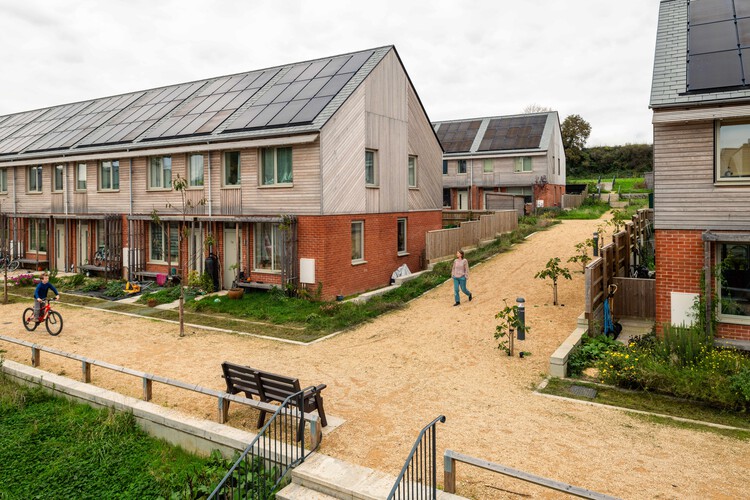
- Car-free streets — children play outside safely; adults encounter neighbours spontaneously

- Short, efficient terraces — create overlaps and smaller groups with shared neighbours

- Deck access — gives apartment building openness

- Designed by Barefoot Architects (Sam Goss)

LILAC Cohousing — Leeds

LILAC, Leeds — Low Impact Living Affordable Community (20 homes)

Community Website: www.lilac.coop

Community Schemes Implemented:

- Mutual Home Ownership Society (MHOS) — pioneering equity-based leaseholder scheme; residents are their own landlords

- Community Agreements — cover pets, food, communal cooking, garden upkeep, equal opportunities, vulnerable adults

- Shared meals twice weekly — structured community bonding

- Learning Days — 25 learning days for 679 participants since 2013; 4 tours/year

- Leeds Community Homes — spin-off cooperative replicating the model across Leeds City Region

Financial Scheme:

- Mutual Home Ownership Society (MHOS) — members contribute ~35% of net household income; equity shares decoupled from market

- Triodos Bank long-term mortgage — ethical finance

- Homes and Communities Agency Low Carbon Investment Fund — £420,000 government grant specifically for ModCell straw construction experiment

- Personal members' invested capital — deposits

- Minimum income threshold — £15,000/year household minimum (2015) to ensure 35% equity share covers mortgage

Design/Construction Details:

- ModCell® system — pre-made timber frame, straw bale, and lime render panels; airtight and super-insulated

- Large south-facing glazed panels — maximise sunlight and solar gain

- Inward-facing design — increases opportunities for meeting, conversing, and watching out for neighbours

- Common house — shared kitchen, laundry, guest rooms, workshop, meeting space; also used as local polling station

- Car-free home zones + car sharing club

- Allotments, pond, permaculture gardens

BedZED — London (Hackbridge, Sutton)

BedZED, London — UK's first large-scale zero-carbon eco-village (100 homes)

Community Website: No dedicated residents' site; managed by Bioregional

Community Schemes Implemented:

- One Planet Living framework — free-to-use sustainability framework for ongoing community stewardship

- ZEDcars car club — shared electric vehicles; estimated £1,391/year savings per household

- Local organic food delivery scheme — reduces food miles and packaging

- Resident environmental stewardship — long-term community engagement with biodiversity and green space maintenance

Financial Scheme:

- Developed by Peabody Trust (now Peabody) and Bioregional in 2002

- Mixed tenure — 2/3 affordable housing (social rent/shared ownership)

- Innovative financing at the time: capital costs partially offset by energy savings and reduced infrastructure (no car parking)

- Homes sold at discount reflecting self-build labour input (inspired by Walter Segal model)

Design/Construction Details:

- 100 homes — mix of flats, maisonettes, and townhouses

- 300mm super-insulation — high thermal mass, triple-glazed windows

- Passive solar design — south-facing conservatories act as heat collectors

- Wind-driven ventilation cowls — the iconic colourful "windcatchers" on roofs — passive stack ventilation with heat recovery

- Green roofs and living roofs — biodiversity, stormwater management, thermal insulation

- Solar PV panels integrated into south-facing facades

- Rainwater harvesting — greywater recycling

- Timber-frame construction from sustainably managed forests

- Pedestrianised streets — car-free central spine; parking at periphery

- Private gardens for 71 of 82 homes + village square + sports pitch + green corridors

The Spine — Liverpool

The Spine, Liverpool — WELL Platinum headquarters of the Royal College of Physicians

Community Website: www.spacesatthespine.co.uk

Community Schemes Implemented:

- Public ground-floor café and exhibition space — educates public on health issues; community events

- The Knowledge Quad — onsite training facility created to address construction skills shortages; 539 apprentice weeks, 345 NVQ weeks, 153 undergraduate weeks

- 75% local return on cost — £28.8m back into Liverpool economy

Financial Scheme:

- £35 million construction cost (shell & core)

- Liverpool City Council + Royal College of Physicians partnership — strategic public-private collaboration within £1bn Paddington Village development

- Liverpool City Region Combined Authority — approved £12m grant toward £20m enabling works

- Heat Energy Network (HEN) — district CHP network; higher capital cost but lower operational costs for occupiers

Design/Construction Details:

- 14-storey, 160,000 sq ft Grade A office

- Architect: AHR Architects | Main Contractor: Morgan Sindall | WELL AP: CBRE

- WELL Platinum (109/110 points) — highest score globally at completion; BREEAM Outstanding (fit-out) + BREEAM Excellent (shell & core)

- Biomorphic design narrative:

- Vertebrae staircase — helical stair encouraging physical movement, panoramic views to Snowdonia

- "Lungs" sky gardens — double-height atria with NASA-researched high-oxygen plants (Mandarin Plant, Birds Nest Fern)

- Trabecular bone columns — exposed concrete moulded to reflect bone structure

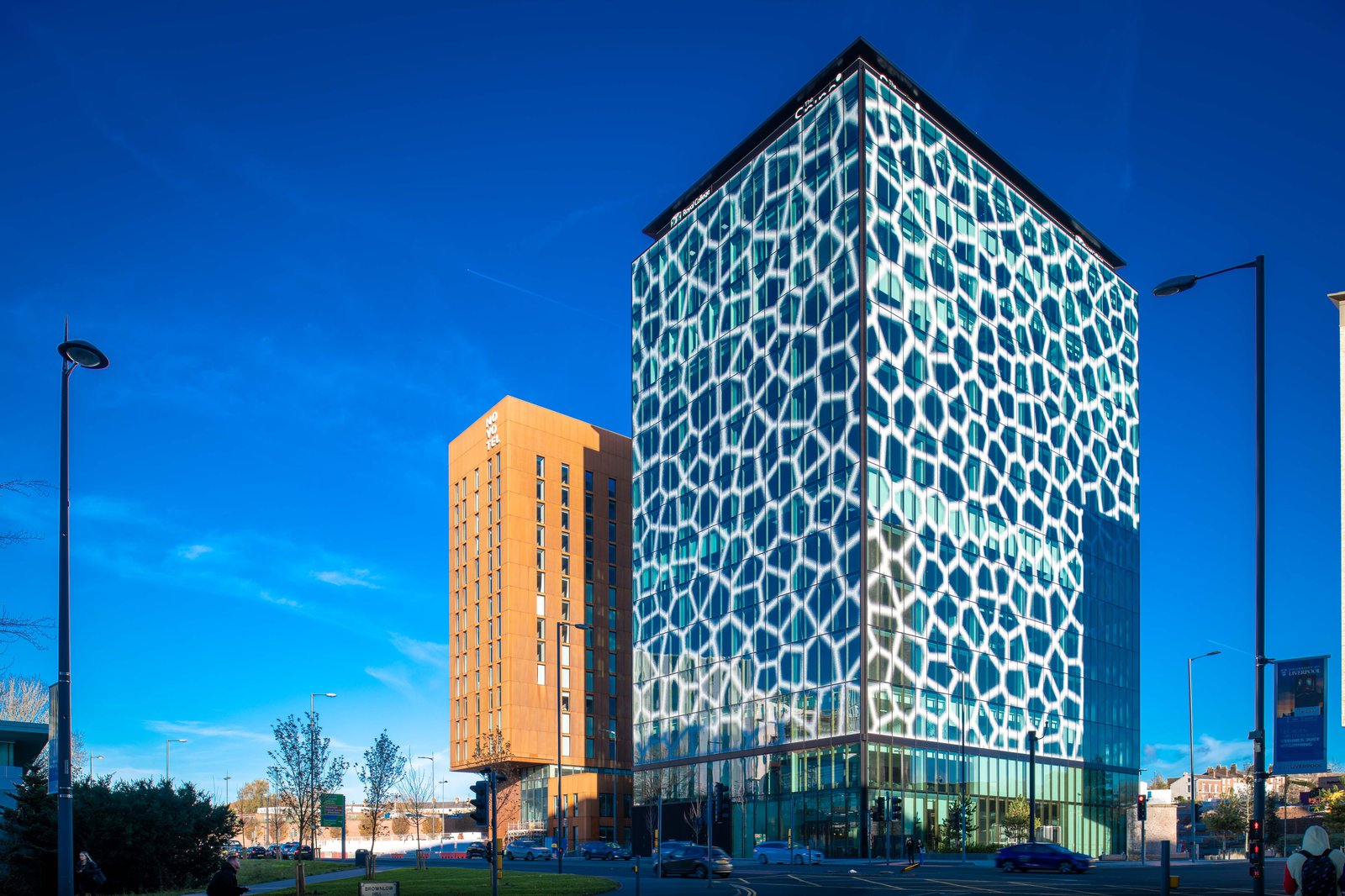
- Voronoi-pattern facade — 23 million individual polygons mimicking human skin cells; creates dappled forest-canopy shadows

- 1,400 unique glass panels — reduce glare and noise

- Workstations within 7.5m of windows — personal environmental control dashboards for light and temperature

- Clay plaster ceilings — acoustic absorption + humidity balance

- Tarkett DESSO AirMaster flooring — 4x better fine dust capture than standard carpet

- Colour palette — earth tones (lower floors) → green/leafy (middle) → blue (upper floors), echoing a tree rising through the building

- WELL standards added only ~2% to build cost (excluding plants)

The Round — London (Blackfriars)

The Round, London — Foster + Partners' WELL Community Gold Standard high-rise (completion 2030)

Community Website: www.hines.com/properties/the-round-london

Community Schemes Implemented:

- WELL Community Gold Standard — first UK high-rise targeting this; 360-degree wellness framework

- Pillar Wellbeing matrix — environment, movement, mindset, social, nutrition, recovery

- 300-seat auditorium — year-round cultural programming for local communities and businesses

- Social enterprise-run community café

- Children's play areas — integrated into the public realm

- Cycle highway connections — car-free travel encouragement

Financial Scheme:

- Developer: Hines (US firm)

- Estimated value: £1 billion (originally reported as £2bn; later clarified to ~£1bn)

- BGO (BentallGreenOak) — considering £500m loan facility

- Section 106 package with Southwark Council:

- £74m Community Infrastructure Levy (CIL) payment

- £12m affordable workspace contribution

- 20,000 sq ft affordable workspace — social enterprise provision

- Main construction start: Spring 2027 (estimated)

Design/Construction Details:

- Architect: Foster + Partners

- Tallest tower: 47 storeys

- Oval-shaped courtyard — the "Round" namesake; circular cultural hub at the heart

- Gardens every three floors — more terraces than any London tower; 69 new trees

- Cascading green terraces — bring social dimension to workplace

- Flexible floorplates — designed for longevity and adaptability

- Fossil-fuel free, 100% electric, net-zero carbon — no gas connections

- WELL Community Gold Standard — extends beyond building to neighbourhood-level wellness

Jaywick Sands Healthy Homes Team — Jaywick Sands, Essex

Community Website: www.tendringdc.gov.uk

Community Schemes Implemented:

- Proactive tenant identification — data-driven outreach to find at-risk residents before crisis

- Housing-health-service connection — integrated referral pathways between environmental health, NHS, and social care

- Community transport — £210,000 for three new community transport mini-buses (part of wider regeneration)

- Acquisition of derelict/vacant sites — £200,000 to expand Healthy Homes initiative

Financial Scheme:

- NHS North East Essex Health and Wellbeing Alliance — £900,000 two-year grant (funds the four-strong officer team)

- Ministry of Housing, Communities & Local Government — £19.7m Community Regeneration Partnership funding for Clacton/Jaywick Sands place-based regeneration

- Additional £20m for Clacton Civic Quarter (separate grant)

- Shortlisted for 2025 National Healthy Housing Awards (Outstanding Achievement)

Design/Construction Details:

- No new-build construction — this is a systems intervention in existing housing stock

- Focus on damp/mould remediation, heating improvements, and health-service brokerage

- Works in one of England's most deprived coastal areas

CMHHP — Cheshire & Merseyside

Community Website: www.cheshireandmerseyside.nhs.uk

Community Schemes Implemented:

- Four strategic workstreams:

Research Category

Healthy Homes

141. Healthy Homes — damp/mould remediation, respiratory illness interventions, integrated referral pathways+
152. Mental Health + Housing — specialised housing for severe mental illness; embedding housing expertise in mental health services; early intervention+
163. Public Health Promotion — using housing association community programmes to tackle food insecurity, poverty, and health inequalities+
174. Workforce Opportunities — NHS career pathways for social housing tenants; simplifying recruitment between housing associations and NHS+

- Supported by HACT (Housing Association Charitable Trust) — national housing-health research and practice charity

Financial Scheme:

- Strategic partnership — no single capital fund; instead, pooled resources from:

- Cheshire and Merseyside Health and Care Partnership (HCP) — ICS (Integrated Care System)

- Local housing associations

- HACT (support and research backbone)

- Rooted in Sir Michael Marmot's All Together Fairer recommendations

Design/Construction Details:

- No single building — this is a system architecture across a geography

- Focus on integration mechanisms rather than physical design:

- Shared data systems between housing and health

- Joint assessment protocols

- Embedded housing specialists in mental health teams

14.2 Cross-Cutting Analysis Tables

Community & Governance Models

ProjectCommunity WebsiteGovernance ModelKey Community Scheme
Hope GardensNone (Centrepoint)PIE trauma-informedResident-decorated spaces
Aviary HouseNone (Home Group)Supported living + NHSPeer support + school links
Church Grovetheruss.orgCLT + self-buildRUSS School of CLH; 90-volunteer hub
HazelmeadBridport Cohousing/BCHASociocracyCommunity microgrid; resident-built common house
LILAClilac.coopMHOS cooperativeLearning Days (679 participants); Leeds Community Homes spin-off
BedZEDNone (Bioregional)Resident stewardshipZEDcars; One Planet Living
The Spinespacesatthespine.co.ukRCP anchor tenantPublic café/exhibition; skills training (539 apprentice weeks)
The Roundhines.comHines developer-led300-seat auditorium; social enterprise café
Jaywick Sandstendringdc.gov.ukCouncil-NHS partnershipProactive identification; community transport
CMHHPcheshireandmerseyside.nhs.ukICS + housing assoc. + HACTWorkforce pathways for tenants; food insecurity programmes

Financial Mechanisms — What Works for What Scale

ScaleMechanismExample Projects
Individual/homeMutual Home Ownership Society (35% of income)LILAC
Small community (20–50 homes)CLT + social investment + GLA grant + self-build labour discountChurch Grove, Hazelmead
Estate/village (100+ homes)Mixed tenure + ERDF + HCA + revenue-funded supportBedZED, Aviary House
Commercial officePublic-private partnership + anchor tenant + CILThe Spine (£35m), The Round (£1bn)
Existing stock interventionNHS grant + government regeneration fundJaywick Sands (£900k + £19.7m)
System-levelICS pooled budget + housing association contribution + charity supportCMHHP

Design/Construction Details — Replicable Innovations

InnovationProjectsInvestor/Planner Takeaway
Self-build labour discountChurch Grove, Hazelmead (common house)Reduces construction cost 15–25%; increases resident attachment
SIP + air-source heat pump + MVHRHazelmeadAchieves near-Passivhaus performance without Passivhaus cost
ModCell straw bale panelsLILACCarbon-negative construction; £420k HCA grant proved viability
Voronoi frit facadeThe Spine23m polygons create circadian light at ~2% cost premium
Sky gardens with NASA plant researchThe SpineAir quality + cognitive performance; no automated irrigation (staff engagement)
Community microgrid (PV + battery)HazelmeadEnergy cost resilience; CLT-owned infrastructure
Car-free streets + peripheral parkingBedZED, Hazelmead, LILACReduces infrastructure cost; increases social contact and child safety
Section 106 wellness infrastructureThe Round£74m CIL + £12m affordable workspace = developer obligation as wellness enabler
250-year lease at £1Church GroveRemoves land cost from affordability; legally binds social outcomes
Resale price decoupled from marketChurch Grove, LILACPermanent affordability in perpetuity; protects against gentrification

The "Ladder" of Wellness Investment

For UK property investors and developers, these projects demonstrate a progression of wellness integration:

Research Category

Wellness Building Standards

181. Systems/Policy (lowest capital, highest leverage) — Jaywick Sands, CMHHP+
192. Governance/Ownership Model — LILAC (MHOS), Church Grove (CLT), Hazelmead (sociocracy)+
203. Design/Spatial Intervention — BedZED (green infrastructure), Hazelmead (car-free streets)+
214. Construction/Material Innovation — LILAC (ModCell), The Spine (biophilic materials)+
225. Certification/Brand Premium — The Spine (WELL Platinum), The Round (WELL Community Gold)+
236. Full Ecosystem Integration — The Round (£1bn mixed-use with wellness as the product)+

The most replicable models for mid-scale UK developers are Church Grove (CLT + self-build + GLA grant) and Hazelmead (cohousing + SIP construction + community microgrid), both of which achieved award-winning outcomes with non-standard finance and resident co-production.

247. Summary for Property & Systems Integration+

For anyone designing wellness-oriented property systems, the UK evidence points to several non-negotiables:

Wellness-Oriented Property Systems: Integration Matrix

DomainIndividual WellnessCommunity Wellness
Physical ConditionsEliminate damp, mould, and cold; ensure ventilation and thermal comfortReduce health inequalities linked to poor housing stock
Space StandardsPrevent overcrowding; ensure privacy and room for study/playDesign communal spaces that foster incidental interaction
SecurityAbolish "no fault" evictions; provide tenancy stabilityCreate mixed-tenure, intergenerational communities
AccessibilityMeet M4(2) standards as minimum; enable ageing in placeEnsure inclusive neighbourhoods with accessible amenities
Nature & Green SpaceProvide private amenity space and access to natureInvest in green/blue infrastructure for social prescribing
Care IntegrationEmbed mental health support in housing servicesPlan supported housing as core health infrastructure
Energy & ClimateEliminate fuel poverty; ensure efficient, resilient homesReduce systemic costs to NHS and social care

Integrating Wellness

The UK policy landscape is moving in the right direction — through Awaab's Law, the reformed Decent Homes Standard, the Renters' Rights Bill, and Healthy Homes guidance — but implementation remains constrained by local capacity, funding, and the need for deeper cross-sector collaboration between health, planning, and housing.

The most effective interventions are those that integrate housing, health, and community across sectors — IPSAs, PIE environments, embedded mental health workers in housing associations, and CLTs that combine secure tenure with social infrastructure. These models treat wellness not as an amenity but as infrastructure.

Sources cited in this briefing include: Chartered Institute of Housing (CIH), MHCLG Healthy Homes Guidance, English Housing Survey 2024-25, National Housing Federation, UCL Institute of Health Equity (Marmot Review), NIHR systematic reviews, Bennett School of Public Policy Cambridge, Shelter, Citizens Advice, Royal College of Psychiatrists, National Housing Federation/Look Ahead reports, Ageing Better State of Ageing 2025, Social Market Foundation, Avison Young, TRUUD/HAUS Model, NHS England Healthy New Towns Programme, London Assembly Housing Committee 2025, Mental Health Foundation, Campaign to End Loneliness, Housing LIN, Agile Ageing Alliance, and various academic systematic reviews on housing and health.

02 / Visual Research Compendium

Exemplary UK Housing Projects: Wellness Features, Design Evidence & Outcomes

A Visual Research Compendium — All Images Verified Against Actual Buildings

011. Hope Gardens — West London+

Psychologically Informed Environment (PIE) Supported Housing

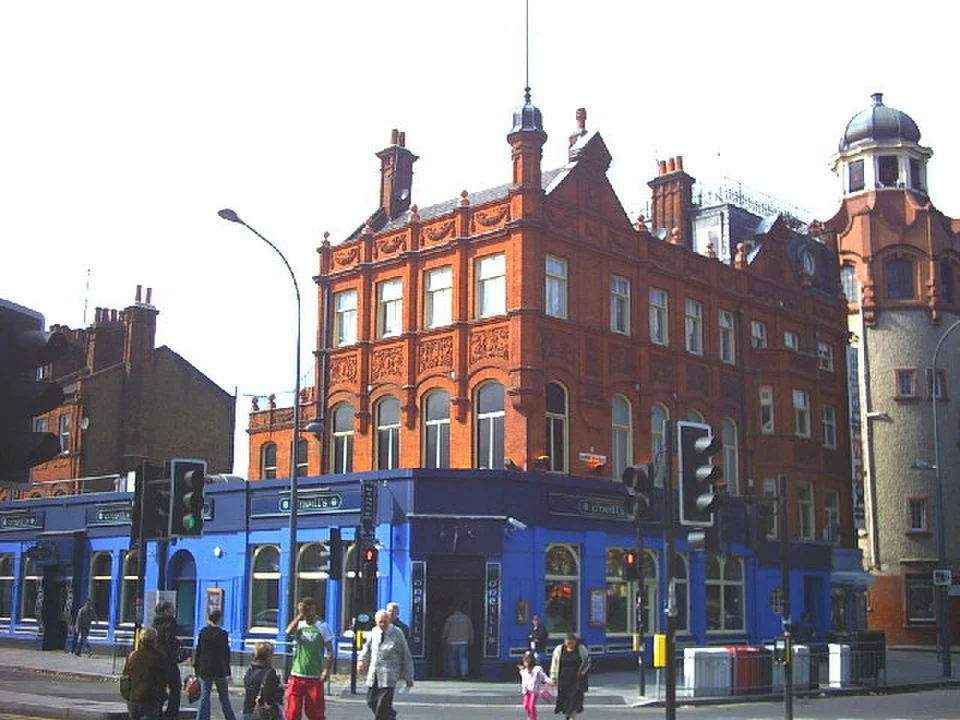
Hope Gardens - Shepherd's Bush Empire building

The former Shepherd's Bush Empire building, now Hope Gardens — a 27-bed PIE-supported housing scheme run by St Mungo's. Verified source: Wikimedia/Mapcarta.

Design FeatureWellness OutcomeEvidence
Private lockable roomsSafety, autonomy, trauma recoveryEach resident has their own room with a lock for personal space and security
Female-only safe spacesGender-specific safety, reduced anxietyAddresses gender-based vulnerabilities among homeless populations
Flexible support for couplesRelationship stabilityPrevents partner separation during recovery
Private family/therapy roomFamily reunification, mental healthAllows private therapy and family visits
Resident-decorated communal areasOwnership, belonging, motivationInformation displays help residents feel welcome and motivated
Resident contribution roles (breakfast, plants, bingo)Purpose, routine, self-efficacyFosters engagement with support services

Documented Outcomes: 74% positive move to more independent housing (higher than organisational average) | 93% client satisfaction | 8 full-time staff, 24-hour waking cover

"Every step of the way, we try to make sure Hope Gardens is a positive environment where people want to live and can feel positive about their lives." — Amy Rice, Service Manager

022. Aviary House — North Solihull+

Step Up Step Down (SUSD) Mental Health Supported Living

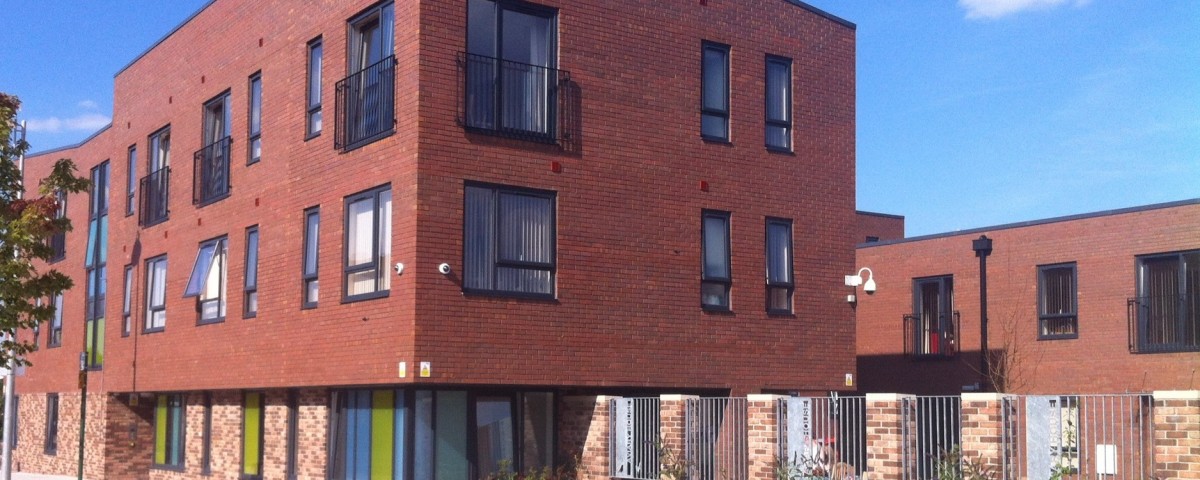
Aviary House - Smith's Wood

Aviary House on Burton's Way, Smith's Wood — a 28-apartment supported living scheme. Verified source: North Solihull Partnership opening photography.

Design FeatureWellness OutcomeEvidence
28 self-contained apartmentsIndependence, dignity, autonomyPeople with complex mental health issues live as independently as possible
Four dedicated SUSD respite flatsCrisis prevention, hospital avoidanceNHS-funded step-down beds prevent readmission cycles
24/7 specialist staff on-siteSafety, immediate supportSupport available as and when needed
Integrated village centre locationCommunity belonging, reduced isolationLocated with retail, school, and planned health centre
Near-independent living with safety netConfidence building, graduated independenceEnables near-independent lives whilst maintaining access to support

Documented Outcomes: 52% wellbeing improvement (resident-reported) | £71,000 net annual saving (2017/18) | Reduced hospital admissions


033. Church Grove Community Land Trust — Lewisham, London+

Community-Led Self-Build Housing (36 homes)

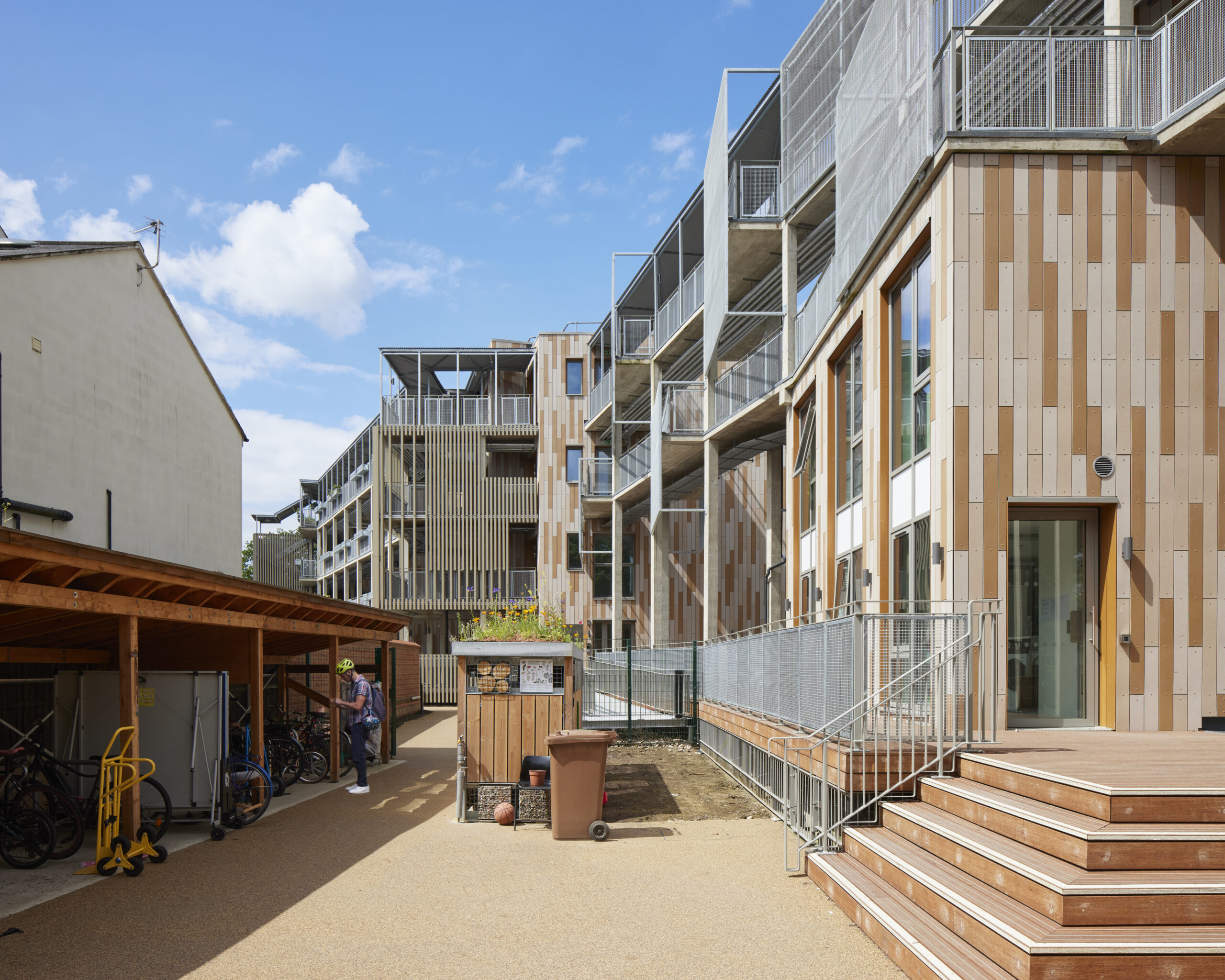
Church Grove - Lewisham

Church Grove, Lewisham — RUSS's first community-led self-build project. Verified source: Rooff Ltd (contractor) construction photography.

Design FeatureWellness OutcomeEvidence
Resident co-design processEmpowerment, agency, belongingFour workshops; residents drew alternative plans; Design Menu recorded priorities
Self-build / self-finish homesSkill-building, pride, ownership5 shell homes handed to residents for fit-out; construction skills gained
Communal laundry, workspace, guest suiteSocial infrastructure, mutual supportShared facilities reduce isolation
Public river access to RavensbourneNature connection, community assetSupports long-term river access aspirations
Communal food growing + edible gardenFood security, physical activityShared outdoor activity and food production
Raised building (1m) with green screenClimate resilience, air qualityReduces overheating and air pollution; mitigates flood risk
Passivhaus-inspired designThermal comfort, healthFabric-first methodology; exceptional airtightness

Documented Outcomes: Permanently affordable tenures in perpetuity | Resident skill acquisition | Community hub self-built by 90 volunteers

"We think of sustainability not just in environmental terms, but economic and social ones too." — Anurag Verma, Chair of RUSS

044. Hazelmead — Bridport, Dorset+

Cohousing (53 homes) — UK's Largest

Hazelmead - Bridport

Hazelmead, Bridport — the UK's largest cohousing development, designed by Barefoot Architects. Verified source: ArchDaily architectural photography.

Design FeatureWellness OutcomeEvidence
Car-free pedestrian streetsSocial interaction, child safety, active travel"Highest upstream design move that facilitates social interaction"
Pergolas with integral benchesNeighbourly interactionLayered transition from public to private; encourages lingering
Unfenced front gardens with swalesNatural surveillance, ownershipDelineated by streets and plants rather than barriers
Common house (timber + strawbale)Community meals, coworking, exerciseHub for communal activities
Sociocratic governanceEmpowerment, reduced conflictConsent-based decision-making
Vaulted ceilings, 2.55m heights, large windowsSpatial generosity, natural light, mental wellbeingResidents specifically requested these features
Scottish acoustic standardsSleep quality, stress reductionExceeds English regulatory minimum
Community microgrid + Tesla batteryEnergy security, reduced bills25% below market cap; surplus reinvested

Documented Outcomes: 47 kWh/m²/year actual energy use | 1.5 m³/hr·m² @50Pa airtightness | RIBA South West Award 2025, RIBA National Award 2025, RIBA Sustainability Award 2025


055. LILAC Cohousing — Leeds+

Low Impact Living Affordable Community (20 homes)

LILAC - Leeds

LILAC (Low Impact Living Affordable Community), Leeds — strawbale-insulated homes with timber cladding. Verified source: Making Lewes documentary photography.

Design FeatureWellness OutcomeEvidence
Mutual Home Ownership Society (MHOS)Tenure security, affordability, empowermentCost linked to wages not market value; resident-controlled governance
Car-free site designChild safety, social interactionSafe environment for all ages
Common house as community hubSocial connection, mutual supportCentral space for eating, meeting, socialising
Homes facing each otherNatural surveillance, neighbourlinessIncreases opportunities for meeting and care
Plentiful greenspace (250m²/household)Nature access, physical activity, mental healthNearly double ward average
High air quality + natural lightRespiratory health, circadian rhythmResidents report improved physical and mental health
MetricLILACNationalImprovement
Health satisfaction76%47%+29pp
Life satisfaction87%58%+29pp
Accommodation satisfaction96%Lower than all other tenuresHighest in UK
Neighbourhood belonging88%18%+70pp
Energy use reduction66%—2.9T CO₂e saving/home/yr
Water use reduction48%—64m³/home/yr

066. BedZED — Beddington Zero Energy Development, London+

Net-Zero Eco-Village (100 homes)

BedZED - London

BedZED, London — the UK's first large-scale zero-carbon community. Verified source: Bioregional official project photography.

Design FeatureWellness OutcomeEvidence
Extra-thick walls + triple-glazingThermal comfort, reduced fuel povertySignificantly reduces heating needs
South-facing sun spacesNatural warmth, daylight, circadian healthCaptures solar heat; reduces traditional heating
Natural ventilation via wind cowlsAir quality, comfortFresh air without energy-intensive AC
Green roofs + community gardensBiodiversity, mental health, food securityWildlife habitats; food growing opportunities
Car-free streets + England's first car clubChild safety, social interactionChildren play safely; people chat in streets
On-site workspacesReduced commuting, work-life balanceMinimises travel; local economic activity
Mixed tenure + sizesSocial diversity, inclusivity1-bed to 4-bed; market, social rent, shared ownership

Documented Outcomes: 90% energy use reduction | ~40% water use reduction | £1,391 annual household savings | RIBA Housing Design Award for Sustainability 2001

"There's a real sense of shared values as well as a strong community feel at BedZED. Combined with the green space nearby and the layout of our streets, it makes it a special place to live." — Dave Tchilingirian, resident

077. The Spine — Liverpool+

WELL Platinum Office / Medical HQ

The Spine - Liverpool

The Spine, Paddington Village, Liverpool — the Royal College of Physicians' northern headquarters. Verified source: Morgan Sindall Construction project photography.

Design FeatureWellness OutcomeEvidence
Voronoi pattern façade (23M polygons)Circadian rhythm, stress reductionCreates dappled shadows like forest canopy; synchronises circadian rhythms
Double-height sky gardens ("lungs")Air quality, oxygen levels, biophiliaHigh-oxygen-producing plants; helical stairs promote movement
Geometric spine staircasePhysical activity, mental refreshmentPanoramic views to Snowdonia; encourages stair use
Trabecular bone-mimic columnsBiomimicry, wonder, salutogenic designExposed concrete reflecting bone structure
Clay plaster ceilingsAir quality, humidity balanceAbsorbs toxins; balances humidity
Personal environmental dashboardsThermal comfort, autonomy, reduced stressIndividual control of lighting and temperature
NASA-researched air-purifying plantsIndoor air quality, cognitive performanceImproves cognitive performance by 10-20%
Biophilic colour progressionPsychological comfortEarthy → green → blue from lower to upper floors

Documented Outcomes: 109/110 WELL Credits (99.1%) — highest globally | WELL Platinum (Core + Fit Out) | BREEAM Outstanding | £28.8m local economic return


088. The Round — London (Southwark)+

Wellness High-Rise Village (£2bn, completion 2030)

The Round - London

The Round, London — Foster + Partners' design visualization for the UK's first WELL Community Gold Standard high-rise. Note: Official design render; building not yet constructed (completion 2030).

Design FeatureWellness OutcomeEvidence
WELL Community Gold StandardHolistic wellness benchmarkFirst UK high-rise to pursue this; addresses 6 wellness pillars
Rooftop terrace + garden every 3 floorsNature access, biophilia, social interactionMore terraces than any London tower; 69 new trees
Hot and cold therapy roomsPhysical recovery, stress reductionEvidence-based thermal therapy
Napping podsSleep health, cognitive restorationWorkplace wellness for fatigue management
Digital detox spacesMental health, attention restorationSpaces free from digital stimulation
Art therapy + breathwork + meditationMental health, mindfulness, communityProgrammed activities addressing depression and anxiety
Fossil-fuel free, net-zero carbonEnvironmental health, clean air95% heat from ground-source heat pumps

Documented Targets: 1 million sq ft | 5,000 office workers | 433 homes (40% affordable) | WELL Community Gold Standard | Completion: 2030


099. Jaywick Sands Healthy Homes Team — Essex+

Council-NHS Partnership Intervention

No building image available — This is a service intervention model rather than a physical building project.

Design FeatureWellness OutcomeEvidence
Proactive tenant identificationEarly intervention, preventionIdentifies tenants in poor housing before health deteriorates
Integrated health-service connectionCare coordinationConnects tenants with health and support services
Multi-agency collaborationHolistic supportCouncil and NHS working together
Targeted disrepair interventionRespiratory + mental healthAddresses damp, mould, cold directly

Documented Outcomes: Shortlisted for 2025 National Healthy Housing Awards (Outstanding Achievement) | Improved physical and psychological health | Proactive rather than reactive service model


1010. Cheshire and Merseyside Health and Housing Partnership (CMHHP)+

Strategic Health-Housing Integration

No building image available — This is a strategic partnership framework rather than a single physical development.

Design FeatureWellness OutcomeEvidence
Healthy Homes pathwayRespiratory illness reductionTargeted interventions; integrated pathways
Mental Health and Housing streamHospital avoidance, recoverySpecialised housing for severe mental illness; early intervention
Public Health via housing associationsHealth inequalities, food insecurityUtilising community programmes to tackle social determinants
Workforce pathways for tenantsEconomic security, purposeSimplified entry into health and social care jobs

Documented Outcomes: Reduced hospital admissions and readmissions | Strengthened community empowerment | Based on Sir Michael Marmot's All Together Fairer recommendations


11Quantified Evidence: Charts+

Chart 1: Wellbeing & Performance Outcomes Across Projects

Wellbeing Outcomes Chart

Chart 2: Environmental Performance Metrics

Environmental Performance Chart

Chart 3: Economic Impact & Return on Investment

Economic Impact Chart

Chart 4: Design Feature to Wellness Outcome Mapping

Design-Wellness Heatmap
12A Few Design Patterns+
PatternProjects Using ItWellness Mechanism
Resident control / co-designChurch Grove, Hazelmead, LILAC, BedZEDAutonomy, agency, ownership → mental health
Car-free / pedestrian priorityHazelmead, LILAC, BedZEDSafety, social interaction, active travel
Shared communal spacesAll 10 projectsSocial connection, mutual support, reduced loneliness
Nature integration / biophiliaBedZED, The Spine, The Round, Hazelmead, LILACStress reduction, air quality, circadian health
Tenure security / affordabilityChurch Grove, Hazelmead, LILAC, BedZEDReduced anxiety, housing stability
Graduated independenceHope Gardens, Aviary HouseConfidence building, reduced institutionalisation
Multi-agency integrationJaywick Sands, CMHHP, Hope Gardens, Aviary HouseHolistic care, prevention
Environmental performanceBedZED, Hazelmead, LILAC, Church Grove, The RoundThermal comfort, fuel poverty elimination
Biophilic / salutogenic designThe Spine, The RoundCognitive performance, stress reduction

Sources: St Mungo's Annual Report, Home Group, North Solihull Partnership, Rural Urban Synthesis Society (RUSS), Rooff Ltd, Barefoot Architects, Bridport Cohousing CLT, LILAC Coop, Bioregional, AHR Architects, Morgan Sindall, Pillar Wellbeing, Hines, Tendring District Council, Cheshire and Merseyside NHS, Housing LIN, RIBA, ArchDaily, RIBA Journal, Future of London, Re-Dwell, Journal of Biophilic Design, Global Wellness Institute.

03 / Sources & reference notes

References

The reference material below is preserved from the uploaded research documents. Expand the relevant source list when needed.

Sources cited

Sources cited in this briefing include: Chartered Institute of Housing (CIH), MHCLG Healthy Homes Guidance, English Housing Survey 2024-25, National Housing Federation, UCL Institute of Health Equity (Marmot Review), NIHR systematic reviews, Bennett School of Public Policy Cambridge, Shelter, Citizens Advice, Royal College of Psychiatrists, National Housing Federation/Look Ahead reports, Ageing Better State of Ageing 2025, Social Market Foundation, Avison Young, TRUUD/HAUS Model, NHS England Healthy New Towns Programme, London Assembly Housing Committee 2025, Mental Health Foundation, Campaign to End Loneliness, Housing LIN, Agile Ageing Alliance, and various academic systematic reviews on housing and health.

Sources cited in the exemplary precedents

Sources: St Mungo's Annual Report, Home Group, North Solihull Partnership, Rural Urban Synthesis Society (RUSS), Rooff Ltd, Barefoot Architects, Bridport Cohousing CLT, LILAC Coop, Bioregional, AHR Architects, Morgan Sindall, Pillar Wellbeing, Hines, Tendring District Council, Cheshire and Merseyside NHS, Housing LIN, RIBA, ArchDaily, RIBA Journal, Future of London, Re-Dwell, Journal of Biophilic Design, Global Wellness Institute.

[email protected] | +44 203540379 | +44 7426946432

Linden Fairbridge Advisory LTD

Copyright © 2026. All Rights Reserved.

Registered in England and Wales Co No. 17052300